CIA Challenge Exam study plan: coverage and hours
Start with the current one-part Challenge syllabus, diagnose gaps across its five sections, then budget instruction, fresh practice and timed rehearsal. Estimate your calendar from the work you need and the hours you can sustain; another candidate’s study duration is not a reliable personal deadline.
English-language CIA Challenge Exam preparation using the syllabus effective June 2026. This is separate from the standard three-part CIA route. The hours below are an editorial planning example, not an IIA recommendation, average preparation time or pass guarantee.
01 / 6
Confirm the Challenge route and current syllabus first
The IIA currently describes one Challenge Exam with 150 multiple-choice questions in 180 minutes. Its overview says the eligibility pathways share the same content and syllabus, aligned with the 2024 Global Internal Audit Standards. Select the current Challenge syllabus rather than joining three standard-part study calendars together.
Check your approved pathway in CCMS. The professional experience pilot is currently closed to new applications; do not infer eligibility from experience alone. The CPA/CA and CISA pathways have their own requirements. This preparation plan does not determine whether your qualification is accepted.
Source notes: The IIA: current one-part CIA Challenge overview
02 / 6
Build a five-section coverage map
The official syllabus is effective June 2026. Its section weights total 20 + 15 + 20 + 25 + 20 = 100%. Use them to check coverage, then adjust your effort to the errors you actually demonstrate. A published weight is not a guarantee of an exact question count on your sitting.
For each section, record whether you can explain the governing idea, select the next action in a fresh scenario and justify why an alternative is weaker. Familiarity with a textbook chapter is different from being able to make that decision.
| Section | Official weight | A useful output from study |
|---|---|---|
| A. Internal Audit Professionalism and Quality | 20% | Explain independence, objectivity and quality responsibilities. |
| B. Internal Audit Operations and Audit Plan | 15% | Connect audit priorities and resources to the organization’s risks. |
| C. Engagement Planning | 20% | Connect the objective, scope, criteria and work program. |
| D. Engagement Performance | 25% | Explain why evidence and analysis support the conclusion. |
| E. Engagement Results and Monitoring | 20% | Explain communication, action plans and follow-up decisions. |
A. Internal Audit Professionalism and Quality
- Official weight
- 20%
- A useful output from study
- Explain independence, objectivity and quality responsibilities.
B. Internal Audit Operations and Audit Plan
- Official weight
- 15%
- A useful output from study
- Connect audit priorities and resources to the organization’s risks.
C. Engagement Planning
- Official weight
- 20%
- A useful output from study
- Connect the objective, scope, criteria and work program.
D. Engagement Performance
- Official weight
- 25%
- A useful output from study
- Explain why evidence and analysis support the conclusion.
E. Engagement Results and Monitoring
- Official weight
- 20%
- A useful output from study
- Explain communication, action plans and follow-up decisions.
Source notes: The IIA: CIA Challenge Exam syllabus, effective June 2026
Keep practicing
Get the free CIA Part 1 practice PDF
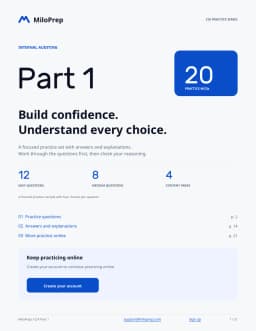
The separate CIA Part 1 PDF contains 20 original fundamentals questions with answers and explanations. It offers a small reasoning sample relevant to some foundational concepts. It is not a Challenge Exam question bank, a five-section coverage test or a 150-question mock.
20 questions
Answers and explanations
No account required to request
Account access is separate: MiloPrep account registration. A PDF request does not create an account or transfer practice answers.
03 / 6
Choose resources by the gap they repair
Use the syllabus to map your main course. Check that it identifies the current Challenge edition and the Global Internal Audit Standards. Before adding another course, name the missing function: instruction, fresh scenario practice, explanation quality or timed rehearsal. More subscriptions do not by themselves repair a misunderstanding.
The IIA’s accounting-pathway page links the syllabus, Challenge-specific practice examinations and a review course. It describes the practice questions as retired exam questions with rationales for correct and incorrect responses, with a maximum of two attempts per practice examination. Check the exact current offer before purchase. Study materials are a separate choice from exam registration.
Use an authorized practice attempt as diagnostic evidence before memorizing its explanations. Record the reasoning error and try a different application after repair. Do not seek or circulate current exam questions, and do not treat repeated-set improvement as a measured increase in your likelihood of passing.
Source notes: The IIA: accounting-pathway preparation resources
04 / 6
Worked calendar: capacity is not a prediction
Illustrative inputs: you can sustain 10 study hours per week for eight weeks. Capacity = 10 × 8 = 80 hours. Suppose your initial task estimate is the 80-hour plan below. Those inputs fit arithmetically, but leave no spare capacity. They are invented planning assumptions, not evidence that 80 hours is sufficient for you.
If your actual capacity is six hours per week, the same assumed workload requires 80 ÷ 6 = 13.33 weeks. With whole six-hour weeks, 13 weeks provide 78 hours and 14 provide 84. Fourteen weeks fit that workload with four spare hours; this says nothing about whether your knowledge gaps require more or less work.
Re-estimate after the diagnostic and again after fresh mixed practice. If the work expands, add realistic capacity, remove genuinely redundant activity or reconsider the appointment under the applicable policy. Simply moving the same tasks into smaller calendar boxes cannot eliminate a shortage.
| Work | Assumed hours | Completion evidence |
|---|---|---|
| Diagnostic and syllabus mapping | 8 | A specific gap list across all five sections |
| Instruction and targeted repair | 48 | Rules explained and applied to new scenarios |
| Fresh mixed practice | 12 | Errors classified and repaired without abandoning stronger sections |
| Two full timed rehearsals | 6 | Two 180-minute sessions completed under the applicable rules |
| Rehearsal analysis and final repair | 6 | Unresolved errors revisited with changed facts |
| Total | 80 | 8 + 48 + 12 + 6 + 6 = 80; no additional buffer included |
Diagnostic and syllabus mapping
- Assumed hours
- 8
- Completion evidence
- A specific gap list across all five sections
Instruction and targeted repair
- Assumed hours
- 48
- Completion evidence
- Rules explained and applied to new scenarios
Fresh mixed practice
- Assumed hours
- 12
- Completion evidence
- Errors classified and repaired without abandoning stronger sections
Two full timed rehearsals
- Assumed hours
- 6
- Completion evidence
- Two 180-minute sessions completed under the applicable rules
Rehearsal analysis and final repair
- Assumed hours
- 6
- Completion evidence
- Unresolved errors revisited with changed facts
Total
- Assumed hours
- 80
- Completion evidence
- 8 + 48 + 12 + 6 + 6 = 80; no additional buffer included
05 / 6
Rehearse decisions and pacing together
Using the current format, average exam time per question = 180 minutes ÷ 150 = 1.2 minutes, or 72 seconds. That average is a planning reference, not a rule that every question deserves exactly 72 seconds. Some items need more reading or reasoning than others.
For an illustrative uninterrupted rehearsal, completing 50 questions in 60 minutes and 100 in 120 leaves 60 minutes for the final 50. These checkpoints simply divide the stated duration proportionally; they do not add a break, override navigation rules or guarantee adequate review time.
Afterward, separate concept errors, incorrect next-action decisions, missed facts and pacing problems. A scenario can be answered incorrectly even when you remember the relevant standard. Explain which fact changes the next action, then try a fresh scenario rather than only rereading the answer.
Source notes: The IIA: current one-part CIA Challenge overview
06 / 6
Turn the budget into weekly evidence
The sequence below illustrates the eight-week, ten-hour capacity assumption. Move checkpoints when the diagnostic reveals a larger gap. Do not force completion on schedule by skipping an entire section or counting passive video time as proof that you can apply a method.
Keep one main record of coverage, source notes and errors. If you evaluate another resource, use a concrete missing topic and inspect its explanation before paying. Anecdotes about finishing quickly or a provider feeling harder do not establish what this particular candidate needs.
- 1
Weeks 1-2: diagnose and repair foundations
Map all five sections and select the largest demonstrated gaps. Explain the internal audit role and relevant standards before moving into engagement decisions.
- 2
Weeks 3-5: connect planning, performance and follow-up
Alternate targeted instruction with unfamiliar scenarios. Identify the objective, relevant facts, justified next action and evidence you would need.
- 3
Week 6: test mixed coverage
Check whether a repaired method survives different wording and whether stronger sections remain active. Recalculate the remaining workload.
- 4
Weeks 7-8: rehearse, analyze and repair
Fit the assumed timed sessions and analysis into actual capacity. If gaps remain, record them and revise the plan rather than declaring readiness from a single percentage.
Apply the method
Change the facts. Check your reasoning.
Original teaching question. Your answer stays on this page and is not transferred to an account.
Sources and scope
Examples and practice questions are original teaching material. Use the linked official sources for current rules and exam policies.
- The IIA: current one-part CIA Challenge overview
Current shared content across pathways, 150 questions in 180 minutes, standards alignment and closure of the professional pilot to new applications. Eligibility and booking remain pathway-specific.
- The IIA: CIA Challenge Exam syllabus, effective June 2026
Five sections and weights:20%,15%,20%,25%,20%. Suggested study outputs, task-hour budgets and weekly sequence are editorial examples, not official allocations.
- The IIA: accounting-pathway preparation resources
Challenge-specific syllabus and practice resources, retired-question rationales and maximum two practice-exam attempts. A resource listing is not an independent comparison of provider outcomes.
Official Challenge Exam overview, accounting-pathway resources and June 2026 syllabus checked 8 November 2026. Verify the applicable syllabus and your approved pathway before booking.