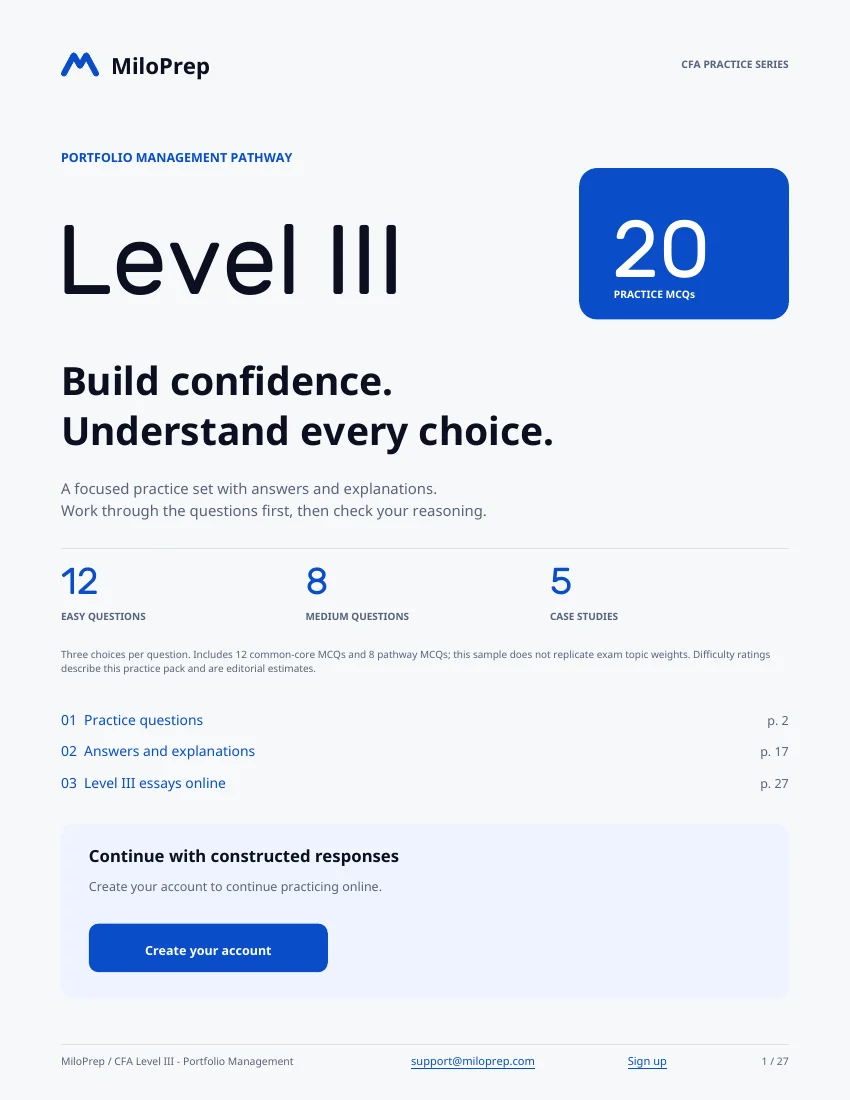
CFA Level III Portfolio Management
Level III Portfolio Management
20 MCQs · Answers & explanations · 27 pages
Portfolio Management pathway
20 multiple-choice questions with answers and explanations. Get the PDF in one email. Work through the questions at your own pace, on screen or on paper.
Inside your inbox
Questions first. Explained answers next.
Preview the actual covers. Request this file free by email.
CFA Level III Portfolio Management
20 MCQs · 27 pages
Explained answers
Multiple-choice practice for the Portfolio Management pathway. This PDF does not contain written-response exercises.
20
Distinct MCQs
1
PDF to keep
$0
No payment
One PDF, delivered by email. Yours to keep.
Choose your pack
Enter your email
Check your inbox
A sample from the MiloPrep question bank.
Know what you are downloading
This is the question distribution in this PDF, rather than the official exam topic weights. It is selected practice with explanations, not complete curriculum coverage or a full mock.
MCQs in this PDF
The 12 common-core questions also appear in the other two Level III PDFs. Each pathway adds eight different MCQs. Written responses are not included.
Work the questions before opening the answer section.
Find the rule or case fact behind the correct answer.
Use a fresh question to test the method you repaired.
Selected practice with explanations. Finishing the sample does not establish exam readiness.
5 original cases, four MCQs per case. Read the vignette and exhibits before the questions.
| Topic | MCQs | Share |
|---|---|---|
| Asset Allocation | 4 | 20% |
| Portfolio Construction | 4 | 20% |
| Ethics and Professional Standards | 4 | 20% |
| Portfolio Management Pathway | 8 | 40% |
The common-core areas listed above contribute 12 MCQs. The pathway contributes 8. This file contains no written-response exercises; the topic list shows its selected coverage.
From CFA Level III - Portfolio Management: Portfolio Management Pathway. This question and its case, when present, are included in the downloadable PDF.
Hassan Kaminski, CFA, meets with the investment committee of Stanmore Airlines following the company's annual earnings release. Stanmore is restructuring its balance sheet, requiring Kaminski to evaluate several fixed-income mandates with distinct objectives and constraints.
First, Kaminski reviews the defined benefit pension plan, which is fully funded and faces a multi-period schedule of projected retirement benefit payments over the next thirty years. The committee's primary objective is minimizing surplus volatility against parallel and non-parallel yield curve movements while maintaining adequate liquidity for benefit distributions. Kaminski evaluates portfolio immunization conditions across the term structure.
Second, Kaminski analyzes the aircraft acquisition fund, a dedicated segregated reserve established to satisfy a single deterministic bullet liability due in three years. Stanmore's corporate treasury policy restricts credit risk and requires Kaminski to immunize this obligation against interest rate shocks while minimizing structural risk from yield curve reshaping.
Third, the committee examines Stanmore's general operating cash reserve, an asset-only portfolio designed to track a broad market aggregate bond index. The index contains thousands of corporate and government issues, including thinly traded debt. Kaminski evaluates methods to replicate this index efficiently given transaction cost constraints.
Finally, Stanmore's chief financial officer recommends replacing the pension plan's custom liability-mirroring benchmark with the broad market aggregate bond index used for the operating reserve. The CFO argues that using a single published index across both mandates reduces administrative complexity, eliminates customized reporting fees, and provides a widely recognized performance standard.
A valid benchmark must meet standard quality criteria: it must be unambiguous (clearly defined identities and weights of constituents), investable (can be held passively), measurable, specified in advance, and appropriate for the mandate.
Start with the common-core cases, then use the Portfolio Management cases to examine fixed-income mandate and trade-execution decisions. Check both the proposed action and the constraint that makes it appropriate.
Write a short explanation of the portfolio effect before reading the answer. Identify the trade direction, relevant exposure and implementation assumption. A correct choice without that reasoning still deserves review.
Add separate written-response practice and cover the remaining pathway outcomes. This MCQ file cannot assess the quality of a written justification or rehearse the complete Level III exam.
Keep a simple record: question number, the rule or case fact you missed, and the fresh exercise you will use to check the correction. Since the explained sample above is already visible, mark it as reviewed if you saw its answer before attempting the file.
Take a look inside
20 questions in every PDF. Answers included.
Level III Portfolio Management
20 MCQs · Answers & explanations · 27 pages
Set aside a focused block of time. Work through 20 questions before turning to the answers.
Review the explanations and identify the concepts you want to revisit.
Print the PDF, mark it up, or save it on your device for your next review session.
Original practice material from MiloPrep. These are sample questions, not a full mock exam or official exam questions.
One PDF with 20 MCQs, including answers and explanations.
No. Enter your email to request the pack. An account is only needed if you choose to practice in the app.
Allow a few minutes and check your spam or promotions folder. Repeat requests for the same pack have a 15-minute cooldown.
Yes, the monthly MiloPrep newsletter. Every email includes an unsubscribe link.
Keep the momentum
Explore interactive questions, explanations, and saved progress in MiloPrep.
Create your free account