CFA Level 1 study plan
Build calculation and reporting foundations, connect the asset classes, then practise mixed questions under time. Keep Ethics in your weekly review from the start.
Your Level 1 study roadmap*
1. Foundations
Quantitative methods and statements
Build calculation and accounting methods, with Ethics every week.
2. Topic coverage
Economics, corporate finance and asset classes
Match the readings to your exam year and pair learning with questions.
3. Integration
Portfolio decisions and mixed review
Retest older topics and classify repeated mistakes.
4. Rehearsal
Timed standalone questions
Practise session pacing, repair errors and prepare for exam day.
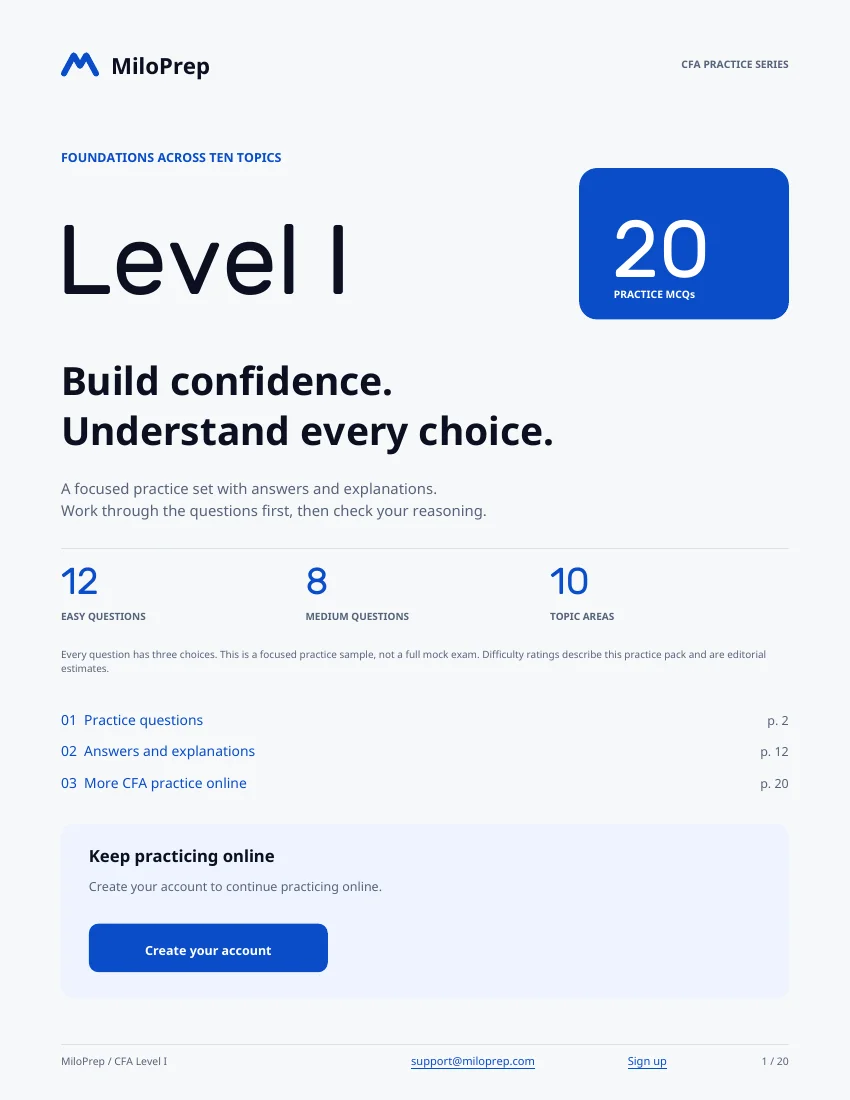
Free PDF by email
CFA Level I: 20 practice MCQs
Enter your email on the PDF page to receive the printable pack, with answers and explanations. Selected level/pathway questions; see the topic mix before requesting.
No account or payment required for the PDFs. Includes the monthly newsletter; unsubscribe anytime.
PDFs by email, with the monthly newsletter. Account signup opens online practice separately.
Build my Level 1 plan
Build a Level I study schedule
Choose your available time, then estimate the curriculum work you need. The starting 300 hours is an editable planning assumption, not a requirement, completion guarantee or pass prediction. This schedule is an order of work, not a substitute for the official learning outcomes.
288 hours across 24 weeks
Each week: learn 5h, practise 5h, review 2h.
Your estimate exceeds this capacity by 12 hours. At 12 hours per week, allow at least 1 additional week, increase weekly time, or reassess the estimate after a diagnostic.
Reserve time for the Practical Skills Module
The hours above cover exam study only. CFA Institute estimates 10-20 hours per Practical Skills Module. Reserve that separately and complete the required module by the results-release deadline. If it must fit inside these weekly hours, reduce your exam-study capacity by the time you reserve.
Check the official PSM requirementsLevel I · 24-week plan
WEEK 1
Quantitative methods
Calculate returns and time value of money; write down the cash-flow timing before using the calculator.
Include Ethics and a retest of an earlier topic in the review hours. Use the official readings and learning outcomes for your registered exam year.
5h learn · 5h practise · 2h review
WEEK 2
Quantitative methods
Apply and retest: work fresh standalone questions on quantitative methods, then redo earlier misses without notes.
Include Ethics and a retest of an earlier topic in the review hours. Use the official readings and learning outcomes for your registered exam year.
5h learn · 5h practise · 2h review
WEEK 3
Financial statement analysis
Connect the statements, calculate ratios and distinguish a cash movement from reported income.
Include Ethics and a retest of an earlier topic in the review hours. Use the official readings and learning outcomes for your registered exam year.
5h learn · 5h practise · 2h review
WEEK 4
Financial statement analysis
Apply and retest: work fresh standalone questions on financial statement analysis, then redo earlier misses without notes.
Include Ethics and a retest of an earlier topic in the review hours. Use the official readings and learning outcomes for your registered exam year.
5h learn · 5h practise · 2h review
WEEK 5
Economics and corporate finance
Explain supply and demand, then connect financing and investment decisions to cash flows.
Include Ethics and a retest of an earlier topic in the review hours. Use the official readings and learning outcomes for your registered exam year.
5h learn · 5h practise · 2h review
WEEK 6
Economics and corporate finance
Apply and retest: work fresh standalone questions on economics and corporate finance, then redo earlier misses without notes.
Include Ethics and a retest of an earlier topic in the review hours. Use the official readings and learning outcomes for your registered exam year.
5h learn · 5h practise · 2h review
WEEK 7
Equity
Distinguish valuation inputs from outputs and test how a changed growth assumption affects value.
Include Ethics and a retest of an earlier topic in the review hours. Use the official readings and learning outcomes for your registered exam year.
5h learn · 5h practise · 2h review
WEEK 8
Equity
Apply and retest: work fresh standalone questions on equity, then redo earlier misses without notes.
Include Ethics and a retest of an earlier topic in the review hours. Use the official readings and learning outcomes for your registered exam year.
5h learn · 5h practise · 2h review
WEEK 9
Fixed income
Price cash flows, explain the price-yield relationship and identify interest-rate and credit risks.
Include Ethics and a retest of an earlier topic in the review hours. Use the official readings and learning outcomes for your registered exam year.
5h learn · 5h practise · 2h review
WEEK 10
Fixed income
Apply and retest: work fresh standalone questions on fixed income, then redo earlier misses without notes.
Include Ethics and a retest of an earlier topic in the review hours. Use the official readings and learning outcomes for your registered exam year.
5h learn · 5h practise · 2h review
WEEK 11
Derivatives
Distinguish a forward commitment from an option and calculate a simple payoff with units.
Include Ethics and a retest of an earlier topic in the review hours. Use the official readings and learning outcomes for your registered exam year.
5h learn · 5h practise · 2h review
WEEK 12
Derivatives
Apply and retest: work fresh standalone questions on derivatives, then redo earlier misses without notes.
Include Ethics and a retest of an earlier topic in the review hours. Use the official readings and learning outcomes for your registered exam year.
5h learn · 5h practise · 2h review
WEEK 13
Alternative investments
Compare structures, fees, liquidity and cash-flow timing without assuming future returns.
Include Ethics and a retest of an earlier topic in the review hours. Use the official readings and learning outcomes for your registered exam year.
5h learn · 5h practise · 2h review
WEEK 14
Alternative investments
Apply and retest: work fresh standalone questions on alternative investments, then redo earlier misses without notes.
Include Ethics and a retest of an earlier topic in the review hours. Use the official readings and learning outcomes for your registered exam year.
5h learn · 5h practise · 2h review
WEEK 15
Portfolio management
Calculate weighted returns and explain diversification and investor constraints.
Include Ethics and a retest of an earlier topic in the review hours. Use the official readings and learning outcomes for your registered exam year.
5h learn · 5h practise · 2h review
WEEK 16
Portfolio management
Apply and retest: work fresh standalone questions on portfolio management, then redo earlier misses without notes.
Include Ethics and a retest of an earlier topic in the review hours. Use the official readings and learning outcomes for your registered exam year.
5h learn · 5h practise · 2h review
WEEK 17
Ethics and first mixed review
Apply the Code and Standards to new facts, then classify errors from a mixed standalone question set.
Include Ethics and a retest of an earlier topic in the review hours. Use the official readings and learning outcomes for your registered exam year.
5h learn · 5h practise · 2h review
WEEK 18
Ethics and first mixed review
Apply and retest: work fresh standalone questions on ethics and first mixed review, then redo earlier misses without notes.
Include Ethics and a retest of an earlier topic in the review hours. Use the official readings and learning outcomes for your registered exam year.
5h learn · 5h practise · 2h review
WEEK 19
Timed standalone questions
Practise three-choice questions at a sustainable pace and revisit the reasoning behind each distractor.
Include Ethics and a retest of an earlier topic in the review hours. Use the official readings and learning outcomes for your registered exam year.
5h learn · 5h practise · 2h review
WEEK 20
Timed standalone questions
Apply and retest: work fresh standalone questions on timed standalone questions, then redo earlier misses without notes.
Include Ethics and a retest of an earlier topic in the review hours. Use the official readings and learning outcomes for your registered exam year.
5h learn · 5h practise · 2h review
WEEK 21
Session rehearsal and repair
Rehearse a 135-minute session with suitable practice material; repair concept and pacing errors separately.
Include Ethics and a retest of an earlier topic in the review hours. Use the official readings and learning outcomes for your registered exam year.
5h learn · 5h practise · 2h review
WEEK 22
Session rehearsal and repair
Apply and retest: work fresh standalone questions on session rehearsal and repair, then redo earlier misses without notes.
Include Ethics and a retest of an earlier topic in the review hours. Use the official readings and learning outcomes for your registered exam year.
5h learn · 5h practise · 2h review
WEEK 23
Final retests and exam preparation
Retest recurring mistakes, verify your appointment and identification, and protect rest before the exam.
Include Ethics and a retest of an earlier topic in the review hours. Use the official readings and learning outcomes for your registered exam year.
5h learn · 5h practise · 2h review
WEEK 24
Final retests and exam preparation
Apply and retest: work fresh standalone questions on final retests and exam preparation, then redo earlier misses without notes.
Include Ethics and a retest of an earlier topic in the review hours. Use the official readings and learning outcomes for your registered exam year.
5h learn · 5h practise · 2h review
If you miss a week
A missed 12-hour week reduces capacity to 276 hours. Move unfinished work into a genuine buffer, add a week if your exam date allows, or reprioritize after a short diagnostic. Do not silently double the next week. Keep Ethics and error-log retests, and record what you deferred.
A session rehearsal needs an uninterrupted 135-minute slot plus review time. Combine or rearrange your practice and review blocks within the weekly total. If that slot does not fit, change the schedule before the rehearsal week.
Use the topic names and readings for your registered year: some headings change in 2027. Add your actual exam appointment and PSM deadline to the printed plan. Changes stay in this page session; they do not save to your account.
What to do next
ACTION 01
Build the foundation first
Start with Quantitative Methods and Financial Statement Analysis foundations, then connect valuation, asset classes, portfolio concepts and Ethics.
Official guidance ↗ACTION 02
Practise throughout
Use questions while learning rather than postponing all practice. There is no penalty for guessing on the exam, but explain every practice choice.
Official guidance ↗ACTION 03
Finish with mixed decisions
Use the final phase for timed mixed sets, formula recall and error-log retests. A completed schedule does not predict a pass.
Official guidance ↗
Sources
Policies, dates and results can change; the official source and registered account control.
MiloPrep is independent and is not affiliated with or endorsed by CFA Institute.
Notes
- * Your Level 1 study roadmap: Illustrative study advice. Adjust the schedule to your baseline and available hours; it does not predict a pass. Choose 12 or 24 weeks in the planner below. Its week numbers follow your selection; these four stages are an overview. ↩ Return to content