CFA Level 1 Fixed Income: notes and free practice
CFA Level 1 Fixed Income connects bond cash flows, prices, yields and risk. A plain bond’s price is the present value of coupons and principal; a higher required yield lowers that value when cash flows are fixed.
The key ideas, at a glance

Discount every promised payment
Read the visual, then follow the worked example below. Use the stated case assumptions.
Illustrative worked case
$ price
- 3%
- 100.97
- 4%
- 100
- 5%
- 99.05
- 6%
- 98.11
- 7%
- 97.2
The case pays $104 in one year. At 5% yield, price is $99.05. Other points change only the required yield.
| Concept | Rule or decision | Common mistake |
|---|---|---|
| Discount every promised payment | Price = PV(coupons) + PV(principal) | A fixed coupon does not make a bond’s market price fixed. |
| Check what the yield includes | Current yield = annual coupon / market price | Two yields with different compounding conventions are not directly comparable. |
| Estimate the rate effect | ΔP/P ≈ -modified duration × Δyield | Duration summarizes a specified yield change; it does not capture every source of bond risk. |
| Separate rate risk from credit risk | Benchmark yield + spread → required yield | Collateral and seniority can reduce loss severity without eliminating default risk. |
01Discount every promised payment
Price = PV(coupons) + PV(principal)
Watch for: A fixed coupon does not make a bond’s market price fixed.
02Check what the yield includes
Current yield = annual coupon / market price
Watch for: Two yields with different compounding conventions are not directly comparable.
03Estimate the rate effect
ΔP/P ≈ -modified duration × Δyield
Watch for: Duration summarizes a specified yield change; it does not capture every source of bond risk.
04Separate rate risk from credit risk
Benchmark yield + spread → required yield
Watch for: Collateral and seniority can reduce loss severity without eliminating default risk.
Selected 2026 study concepts. Match your preparation to your registered exam-year curriculum. These notes are not complete curriculum coverage.
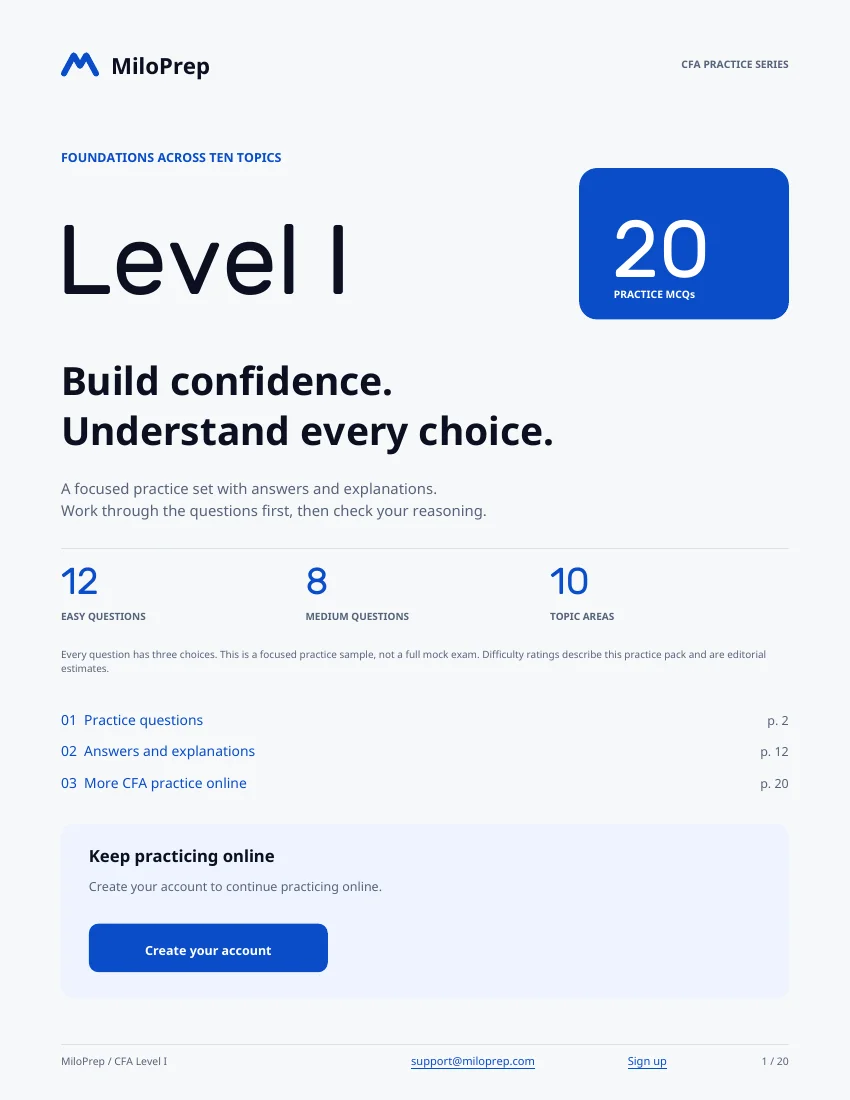
Free PDF by email
CFA Level I: 20 practice MCQs
Enter your email on the PDF page to receive the printable pack, with answers and explanations. Selected level/pathway questions; see the topic mix before requesting.
No account or payment required for the PDFs. Includes the monthly newsletter; unsubscribe anytime.
Put the method to work
One worked example, from facts to answer
Given
A one-year bond repays $100 plus a $4 coupon; annual yield is 5%.
Method
(100 + 4) / 1.05.
Answer and interpretation
Price is approximately $99.05, below par because coupon rate is below yield.
Original independent teaching example. Assumptions are stated above; this is not an official exam question or scoring key.
Try it here - no account needed
10 free Fixed Income questions
Choose an answer, check the reasoning, then use ‘Review the method’ to revisit the exact idea. Selected practice, not a complete syllabus or pass prediction.
Saved in this tab when storage is available. Responses are not uploaded.
Completed
0 / 10
MCQ correct
0 / 0
Completion is not an exam score.
- Question 1 of 10Level I topic sampleFixed IncomeMultiple choice
A bond pays $5 interest and $100 principal exactly one year from today. With a 4% annual required yield, its price is closest to:
Answer and explanations
Discount the single $105 payment: $105 / 1.04 = approximately $100.96.
Review the method- A - correct: Discount the single $105 payment: $105 / 1.04 = approximately $100.96.
- B: Par would result at a 5% yield matching the coupon rate, not the stated 4% yield.
- C: $109.20 compounds the payment instead of discounting it to today.
- Question 2 of 10Level I topic sampleFixed IncomeMultiple choice
A zero-coupon bond pays $1,000 in two years. At a 5% annual compound yield, its price is closest to:
Answer and explanations
$1,000 / 1.05² = approximately $907.03, discounting the sole payment for both years.
Review the method- A: $952.38 discounts only one year instead of two.
- B - correct: $1,000 / 1.05² = approximately $907.03, discounting the sole payment for both years.
- C: $1,102.50 compounds par forward rather than discounting it.
- Question 3 of 10Level I topic sampleFixed IncomeMultiple choice
A plain fixed-rate bond is valued on a coupon date. Its coupon rate equals its yield with matching payment conventions. Ignoring credit changes, it trades at:
Answer and explanations
With matching coupon and yield conventions, the present value of promised cash flows equals par.
Review the method- A: A discount ordinarily corresponds to coupon rate below the required yield for this plain bond.
- B: A premium ordinarily corresponds to coupon rate above the required yield.
- C - correct: With matching coupon and yield conventions, the present value of promised cash flows equals par.
- Question 4 of 10Level I topic sampleFixed IncomeMultiple choice
A bond pays $6 in annual coupons and trades at $95. Its current yield is closest to:
Answer and explanations
$6 / $95 = approximately 6.32%; current market price is the denominator.
Review the method- A - correct: $6 / $95 = approximately 6.32%; current market price is the denominator.
- B: 6% uses $100 par instead of the stated $95 market price.
- C: 5.70% multiplies 6% by the price ratio rather than dividing coupon by price.
- Question 5 of 10Level I topic sampleFixed IncomeMultiple choice
A yield is quoted as 4% nominal annual with semiannual compounding. The effective annual yield is:
Answer and explanations
(1 + 0.04 / 2)² - 1 = 4.04%, compounding the 2% half-year rate over two periods.
Review the method- A: 2% is the half-year rate, not the effective annual rate.
- B - correct: (1 + 0.04 / 2)² - 1 = 4.04%, compounding the 2% half-year rate over two periods.
- C: 8.16% treats 4% as a half-year rate when it is a nominal annual quote.
- Question 6 of 10Level I topic sampleFixed IncomeMultiple choice
Modified duration is 4.5 and yield rises by 40 basis points. Ignoring convexity, the approximate price change is:
Answer and explanations
-4.5 × 0.004 = -0.018, or -1.80%; the higher yield reduces the fixed-cash-flow bond’s price.
Review the method- A: A yield rise causes a negative duration-only price effect for this fixed-cash-flow bond.
- B: 40 basis points is 0.004, not 0.0004.
- C - correct: -4.5 × 0.004 = -0.018, or -1.80%; the higher yield reduces the fixed-cash-flow bond’s price.
- Question 7 of 10Level I topic sampleFixed IncomeMultiple choice
Two otherwise comparable bonds have modified durations of 2 and 7. For the same small parallel yield increase, which has the greater percentage price decline under duration-only analysis?
Answer and explanations
A larger modified duration gives a larger negative percentage price response to the same yield increase.
Review the method- A - correct: A larger modified duration gives a larger negative percentage price response to the same yield increase.
- B: The shorter duration implies less sensitivity under the approximation.
- C: Different durations imply different first-order percentage price sensitivities.
- Question 8 of 10Level I topic sampleFixed IncomeMultiple choice
A non-callable bond has positive convexity. For a yield decline, adding the convexity term to the duration-only estimate generally:
Answer and explanations
The convexity term is positive for either direction of yield change and increases the duration-only gain for a decline.
Review the method- A: The positive convexity correction adds to the estimated price change.
- B - correct: The convexity term is positive for either direction of yield change and increases the duration-only gain for a decline.
- C: Convexity refines interest-rate sensitivity; it does not remove it.
- Question 9 of 10Level I topic sampleFixed IncomeMultiple choice
Benchmark yields are unchanged, but the required credit spread on a fixed-cash-flow corporate bond widens. Other things equal, its price:
Answer and explanations
The increased required yield discounts the same promised cash flows more heavily.
Review the method- A: A wider spread raises the discount rate and lowers present value.
- B: The coupon is fixed, but the discount rate and market price are not.
- C - correct: The increased required yield discounts the same promised cash flows more heavily.
- Question 10 of 10Level I topic sampleFixed IncomeMultiple choice
Two claims on the same issuer are identical except one has a senior secured claim on adequate collateral and the other is junior unsecured. Under those stated terms, the secured claim generally has:
Answer and explanations
Seniority and adequate collateral can improve recovery and reduce loss severity relative to the stated junior unsecured claim.
Review the method- A - correct: Seniority and adequate collateral can improve recovery and reduce loss severity relative to the stated junior unsecured claim.
- B: A secured creditor can still face issuer default, delay and recovery uncertainty.
- C: The stem specifies different seniority and collateral rights, not identical recovery priority.
Four ideas to put to work
Find the method you need
Start with: Present value, annual versus periodic rates, and converting basis points to decimals.
METHOD 01
Discount every promised payment
Price = PV(coupons) + PV(principal)
- Write coupon dates and the final principal repayment.
- Match the discount rate to each payment period.
- For fixed cash flows, higher discount rates mean lower prices.
Worked example
- Given
- A one-year bond repays $100 plus a $4 coupon; annual yield is 5%.
- Calculate / decide
- (100 + 4) / 1.05.
- Result
- Price is approximately $99.05, below par because coupon rate is below yield.
Watch for: A fixed coupon does not make a bond’s market price fixed.
Practise this ideaMETHOD 02
Check what the yield includes
Current yield = annual coupon / market price
- Current yield ignores the maturity gain or loss and reinvestment.
- Yield-to-maturity is a discount-rate solution, not a guaranteed realized return.
- Effective annual yield = (1 + nominal annual yield / m)^m - 1, with m compounding periods.
Worked example
- Given
- Annual coupon $5 and price $98.
- Calculate / decide
- 5 / 98.
- Result
- Current yield is approximately 5.10%, not necessarily the yield to maturity.
Watch for: Two yields with different compounding conventions are not directly comparable.
Practise this ideaMETHOD 03
Estimate the rate effect
ΔP/P ≈ -modified duration × Δyield
- Convert 10 basis points to 0.001 before multiplying.
- Reverse the sign of the yield change for the duration-only price estimate.
- Use convexity to improve the approximation for larger changes.
Worked example
- Given
- Modified duration is 5; yield rises by 20 basis points.
- Calculate / decide
- -5 × 0.002.
- Result
- Approximate price change is -1%, before convexity or spread changes.
Watch for: Duration summarizes a specified yield change; it does not capture every source of bond risk.
Practise this ideaMETHOD 04
Separate rate risk from credit risk
Benchmark yield + spread → required yield
- A credit-spread change can move price even if benchmark rates stay fixed.
- Read claim seniority and collateral terms when assessing loss severity.
- A rating is an opinion, not a guarantee of repayment.
Worked example
- Given
- Benchmark yield stays at 3%; an issuer’s spread widens from 1% to 2%.
- Calculate / decide
- Required yield rises from 4% to 5%.
- Result
- An otherwise unchanged fixed-cash-flow bond loses value.
Watch for: Collateral and seniority can reduce loss severity without eliminating default risk.
Practise this ideaQuestions about this topic
- How does coupon rate differ from yield?
- Coupon rate determines contractual interest from par; yield measures the required or implied return relative to price and cash-flow timing. A bond can have a fixed coupon while its price and yield change.
- Does current yield equal yield to maturity?
- Generally no. Current yield divides annual coupon by market price. Yield to maturity also reflects principal repayment and payment timing under its compounding assumptions.
- What does duration leave out?
- A duration-only estimate is a local sensitivity to a specified yield change. Convexity, nonparallel curve movements, embedded options, credit changes and other risks can require additional analysis.
Apply the topic to a focused case
CFA Level 1 fixed-income valuation building blocks
Draw a timeline before entering calculator values. The coupon is based on par and the coupon convention; the discount rate is the required yield for the stated compounding convention. A plain bond makes several coupon payments and repays principal at maturity. The maturity-date cash flow therefore includes the final coupon as well as par. Price each promised payment at its own date.
- Case facts
- A three-year zero-coupon bond repays 1,000. Required yield is 6% with annual compounding.
- Apply the method
- PV = 1,000 / 1.06³ = approximately 839.62. There are no interim coupons to add.
- Interpretation
- The price is 839.62 under the stated yield. A higher required yield would lower the price of the same maturity payment.
Independent teaching cases under the stated assumptions, rather than official questions or scoring keys.
Sources and curriculum scope
Official outlines establish curriculum scope. The explanations and worked examples are independent teaching material; the sources do not verify or endorse them.
- 2026 CFA Level I outline: Fixed Income
- 2026 CFA Level 1 curriculum outline
- Official Level 1 format and curriculum
- 2026 bond valuation: prices and yields
- 2027 CFA Level 1 curriculum outline
MiloPrep is an independent study resource, not affiliated with or endorsed by CFA Institute. CFA® and Chartered Financial Analyst® are trademarks owned by CFA Institute.