CFA Level 1 Portfolio Management: notes and free practice
CFA Level 1 Portfolio Management combines investor objectives with risk and return analysis. Portfolio expected return is a weighted average, while portfolio risk also depends on the relationships between assets.
The key ideas, at a glance

Turn needs into constraints
Read the visual, then follow the worked example below. Use the stated case assumptions.
Illustrative worked case
When must these assets fund a payment?
Tuition due next year
Reserve assets for the known near-term payment
Remaining long-horizon capital
Assess its own risk and liquidity constraints
The case’s near-term payment limits the assets available for long-horizon risk. The branches do not prescribe an allocation.
| Concept | Rule or decision | Common mistake |
|---|---|---|
| Turn needs into constraints | Objective + risk tolerance + constraints → investment policy | Strong willingness to take risk does not remove a binding financial constraint. |
| Combine assets, not just labels | Portfolio expected return = sum of weight × expected return | Owning many assets does not guarantee diversification if their risks move together. |
| Match the risk measure to the model | CAPM expected return = risk-free rate + beta × market risk premium | A model-implied expected return is not a promised realized return. |
| Review the decision process | Plan → implement → monitor and rebalance | A recent winner is not automatically the best allocation for the investor’s current objectives. |
01Turn needs into constraints
Objective + risk tolerance + constraints → investment policy
Watch for: Strong willingness to take risk does not remove a binding financial constraint.
02Combine assets, not just labels
Portfolio expected return = sum of weight × expected return
Watch for: Owning many assets does not guarantee diversification if their risks move together.
03Match the risk measure to the model
CAPM expected return = risk-free rate + beta × market risk premium
Watch for: A model-implied expected return is not a promised realized return.
04Review the decision process
Plan → implement → monitor and rebalance
Watch for: A recent winner is not automatically the best allocation for the investor’s current objectives.
Selected 2026 study concepts. Match your preparation to your registered exam-year curriculum. These notes are not complete curriculum coverage.
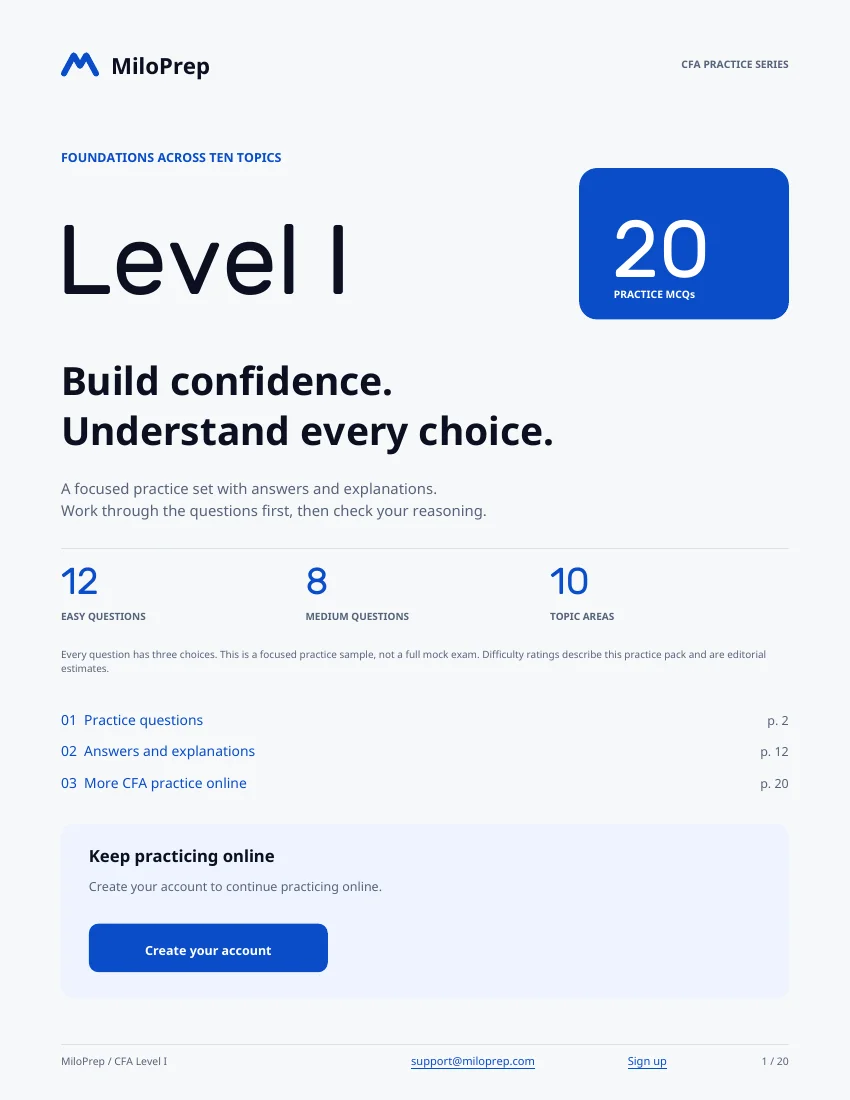
Free PDF by email
CFA Level I: 20 practice MCQs
Enter your email on the PDF page to receive the printable pack, with answers and explanations. Selected level/pathway questions; see the topic mix before requesting.
No account or payment required for the PDFs. Includes the monthly newsletter; unsubscribe anytime.
Put the method to work
One worked example, from facts to answer
Given
An investor wants high growth but must pay tuition from the portfolio next year.
Method
Reserve the known payment before allocating long-horizon risk capital.
Answer and interpretation
The near-term liability limits how much of the portfolio can bear illiquidity and losses.
Original independent teaching example. Assumptions are stated above; this is not an official exam question or scoring key.
Try it here - no account needed
10 free Portfolio Management questions
Choose an answer, check the reasoning, then use ‘Review the method’ to revisit the exact idea. Selected practice, not a complete syllabus or pass prediction.
Saved in this tab when storage is available. Responses are not uploaded.
Completed
0 / 10
MCQ correct
0 / 0
Completion is not an exam score.
- Question 1 of 10Level I topic samplePortfolio ManagementMultiple choice
Which document most directly records an investor’s return objectives, risk tolerance and portfolio constraints?
Answer and explanations
An investment policy statement documents objectives and constraints that guide portfolio decisions.
Review the method- A - correct: An investment policy statement documents objectives and constraints that guide portfolio decisions.
- B: A price chart does not establish the investor’s goals or constraints.
- C: A trade confirmation records an executed transaction, not the overall investment policy.
- Question 2 of 10Level I topic samplePortfolio ManagementMultiple choice
A client is enthusiastic about taking risk but cannot afford a significant loss because essential expenses depend on the portfolio. Which distinction matters most?
Answer and explanations
Psychological willingness and financial ability are separate; the limited ability constrains a suitable risk exposure.
Review the method- A: Willingness does not override the financial consequences of losses and essential spending needs.
- B - correct: Psychological willingness and financial ability are separate; the limited ability constrains a suitable risk exposure.
- C: Investors can have different levels of willingness and ability, as this scenario illustrates.
- Question 3 of 10Level I topic samplePortfolio ManagementMultiple choice
A known $20,000 payment is due from a portfolio in three months. Which constraint most directly governs funding that payment?
Answer and explanations
The portfolio needs sufficient accessible funds when the payment falls due, making liquidity directly relevant.
Review the method- A: Benchmark outperformance does not ensure cash will be available for the known payment.
- B: The stated three-month obligation cannot be treated as having an unlimited horizon.
- C - correct: The portfolio needs sufficient accessible funds when the payment falls due, making liquidity directly relevant.
- Question 4 of 10Level I topic samplePortfolio ManagementMultiple choice
A fully invested portfolio allocates 30% to an asset with expected return 4% and 70% to one with expected return 10%. Its expected return is:
Answer and explanations
0.30 × 4% + 0.70 × 10% = 8.2%, using the portfolio weights.
Review the method- A - correct: 0.30 × 4% + 0.70 × 10% = 8.2%, using the portfolio weights.
- B: 7% is the unweighted average and ignores the 30/70 allocation.
- C: 14% adds the two returns without weighting them.
- Question 5 of 10Level I topic samplePortfolio ManagementMultiple choice
Two assets each have 10% volatility and zero return correlation. An equally weighted portfolio has volatility closest to:
Answer and explanations
Variance = 0.5² × 0.1² + 0.5² × 0.1² = 0.005; its square root is 7.07%.
Review the method- A: 10% ignores the diversification benefit from zero correlation.
- B - correct: Variance = 0.5² × 0.1² + 0.5² × 0.1² = 0.005; its square root is 7.07%.
- C: 5% incorrectly halves volatility without including both assets’ variance contributions.
- Question 6 of 10Level I topic samplePortfolio ManagementMultiple choice
As a portfolio adds many imperfectly correlated individual stocks, which risk generally cannot be eliminated through stock diversification alone?
Answer and explanations
Systematic risk affects the market broadly and remains even when much individual company risk is diversified away.
Review the method- A: Adding suitable imperfectly correlated holdings can reduce, not necessarily increase, company-specific risk.
- B: Diversification does not eliminate common market-wide shocks.
- C - correct: Systematic risk affects the market broadly and remains even when much individual company risk is diversified away.
- Question 7 of 10Level I topic samplePortfolio ManagementMultiple choice
The risk-free rate is 2%, the expected market return is 7% and a stock’s beta is 1.4. Its CAPM expected return is:
Answer and explanations
2% + 1.4 × (7% - 2%) = 9%, applying beta to the market risk premium.
Review the method- A - correct: 2% + 1.4 × (7% - 2%) = 9%, applying beta to the market risk premium.
- B: 11.8% applies beta to the full market return and then adds the risk-free rate.
- C: 7% is the expected market return, not the model return for a stock with beta 1.4.
- Question 8 of 10Level I topic samplePortfolio ManagementMultiple choice
A portfolio return is 11%, the risk-free return is 3% and portfolio volatility is 16%, all measured over the same period. Its Sharpe ratio is:
Answer and explanations
(11% - 3%) / 16% = 0.50, using excess return and matching-period volatility.
Review the method- A: 0.6875 divides total return by volatility without subtracting the risk-free return.
- B - correct: (11% - 3%) / 16% = 0.50, using excess return and matching-period volatility.
- C: 2.00 reverses the required excess-return-to-volatility ratio.
- Question 9 of 10Level I topic samplePortfolio ManagementMultiple choice
An analyst searches only for evidence supporting an existing investment thesis and dismisses contrary evidence without evaluating it. This most directly illustrates:
Answer and explanations
Favoring confirming evidence while discounting contradictions is confirmation bias.
Review the method- A: Unbiased updating requires considering relevant contrary evidence rather than dismissing it.
- B: Selective evidence does not guarantee superior information or investment outcomes.
- C - correct: Favoring confirming evidence while discounting contradictions is confirmation bias.
- Question 10 of 10Level I topic samplePortfolio ManagementMultiple choice
A portfolio’s equity weight rises above its agreed policy band after a market rally. Rebalancing toward the target primarily aims to:
Answer and explanations
Policy-based rebalancing brings exposure back toward the intended allocation, considering costs and constraints.
Review the method- A - correct: Policy-based rebalancing brings exposure back toward the intended allocation, considering costs and constraints.
- B: Rebalancing does not guarantee future performance.
- C: Trading to rebalance can incur costs rather than eliminate them.
Four ideas to put to work
Find the method you need
Start with: Weighted averages, variance, standard deviation and percentages.
METHOD 01
Turn needs into constraints
Objective + risk tolerance + constraints → investment policy
- State the return objective alongside the investor’s risk tolerance.
- Separate willingness to take risk from financial ability to bear losses.
- List liquidity, horizon and other constraints before choosing investments.
Worked example
- Given
- An investor wants high growth but must pay tuition from the portfolio next year.
- Calculate / decide
- Reserve the known payment before allocating long-horizon risk capital.
- Result
- The near-term liability limits how much of the portfolio can bear illiquidity and losses.
Watch for: Strong willingness to take risk does not remove a binding financial constraint.
Practise this ideaMETHOD 02
Combine assets, not just labels
Portfolio expected return = sum of weight × expected return
- Use weights that sum to one for the fully invested portfolio.
- Variance uses squared weights plus covariance terms, not just average volatility.
- Less-than-perfect positive correlation can reduce volatility; systematic risk can remain.
Worked example
- Given
- Weights 50% each; volatilities 10% and 20%; correlation zero.
- Calculate / decide
- Variance = 0.5² × 0.1² + 0.5² × 0.2² = 0.0125.
- Result
- Portfolio volatility is √0.0125 = 11.18%, not the 15% average.
Watch for: Owning many assets does not guarantee diversification if their risks move together.
Practise this ideaMETHOD 03
Match the risk measure to the model
CAPM expected return = risk-free rate + beta × market risk premium
- Beta measures sensitivity to market returns, not total volatility.
- Use the market risk premium, not the market’s entire expected return, in CAPM.
- Sharpe ratio = (portfolio return - risk-free return) / portfolio volatility, with matched periods.
Worked example
- Given
- Risk-free rate 3%, market expected return 8%, beta 1.2.
- Calculate / decide
- 3% + 1.2 × (8% - 3%).
- Result
- CAPM expected return is 9% under the model assumptions.
Watch for: A model-implied expected return is not a promised realized return.
Practise this ideaMETHOD 04
Review the decision process
Plan → implement → monitor and rebalance
- Use the policy’s objectives and constraints to guide implementation.
- Review changed circumstances and weight drift before rebalancing.
- Look for selective evidence, overconfidence and other biases in the decision.
Worked example
- Given
- A policy targets 60% equities; price gains lift equities to 72%.
- Calculate / decide
- Compare the new weight with the policy’s agreed rebalancing range.
- Result
- A policy-based rebalance can restore intended risk exposure, subject to costs and constraints.
Watch for: A recent winner is not automatically the best allocation for the investor’s current objectives.
Practise this ideaQuestions about this topic
- Why is portfolio risk not just the average asset risk?
- Assets can move together imperfectly. Portfolio variance incorporates weights, individual variances and covariances, so their joint behavior matters as well as their separate volatilities.
- How do risk willingness and risk capacity differ?
- Willingness is an investor’s preference toward uncertainty. Capacity reflects financial circumstances and obligations. A suitable portfolio considers both rather than assuming enthusiasm for risk creates the ability to bear losses.
- Can diversification remove every risk?
- No. Diversification can reduce exposure to risks that are not shared across holdings, but a portfolio still faces common market risks and can experience losses.
Apply the topic to a focused case
CFA Level 1 portfolio risk and return measures
Use each asset’s portfolio weight at the point specified by the question, multiply by its expected return and add the products. A fully invested long-only example normally has weights summing to one. Expected return is a model input or estimate rather than a guaranteed outcome. Do not use the expected-return weighted-average formula to average standard deviations; risk requires joint behavior.
- Case facts
- Weights are 60% and 40%; expected returns are 8% and 4%. Both assets have 10% volatility and correlation 0.50.
- Apply the method
- Expected return = 0.60 × 8% + 0.40 × 4% = 6.4%. Variance = 0.60² × 0.10² + 0.40² × 0.10² + 2 × 0.60 × 0.40 × 0.10 × 0.10 × 0.50 = 0.0076.
- Interpretation
- Portfolio volatility is √0.0076, approximately 8.72%. Return is a weighted average; volatility requires the covariance term.
Independent teaching cases under the stated assumptions, rather than official questions or scoring keys.
Sources and curriculum scope
Official outlines establish curriculum scope. The explanations and worked examples are independent teaching material; the sources do not verify or endorse them.
- 2026 CFA Level I outline: Portfolio Management
- 2026 CFA Level 1 curriculum outline
- Official Level 1 format and curriculum
- 2026 portfolio risk and return
- 2027 CFA Level 1 curriculum outline
MiloPrep is an independent study resource, not affiliated with or endorsed by CFA Institute. CFA® and Chartered Financial Analyst® are trademarks owned by CFA Institute.