CFA Level III: format, topics and preparation
CFA Level III tests portfolio decisions through cases and written responses. Choose Portfolio Management, Private Markets or Private Wealth for the specialized pathway.

Level III at a glance*
| What you need | The answer |
|---|---|
| Exam format | 11 item sets + 11 constructed-response sets |
| Session time | Two 132-minute sessions |
| Practice target | Answer the command word using the client or portfolio constraints |
Exam format
- 11 item sets + 11 constructed-response sets
Session time
- Two 132-minute sessions
Practice target
- Answer the command word using the client or portfolio constraints
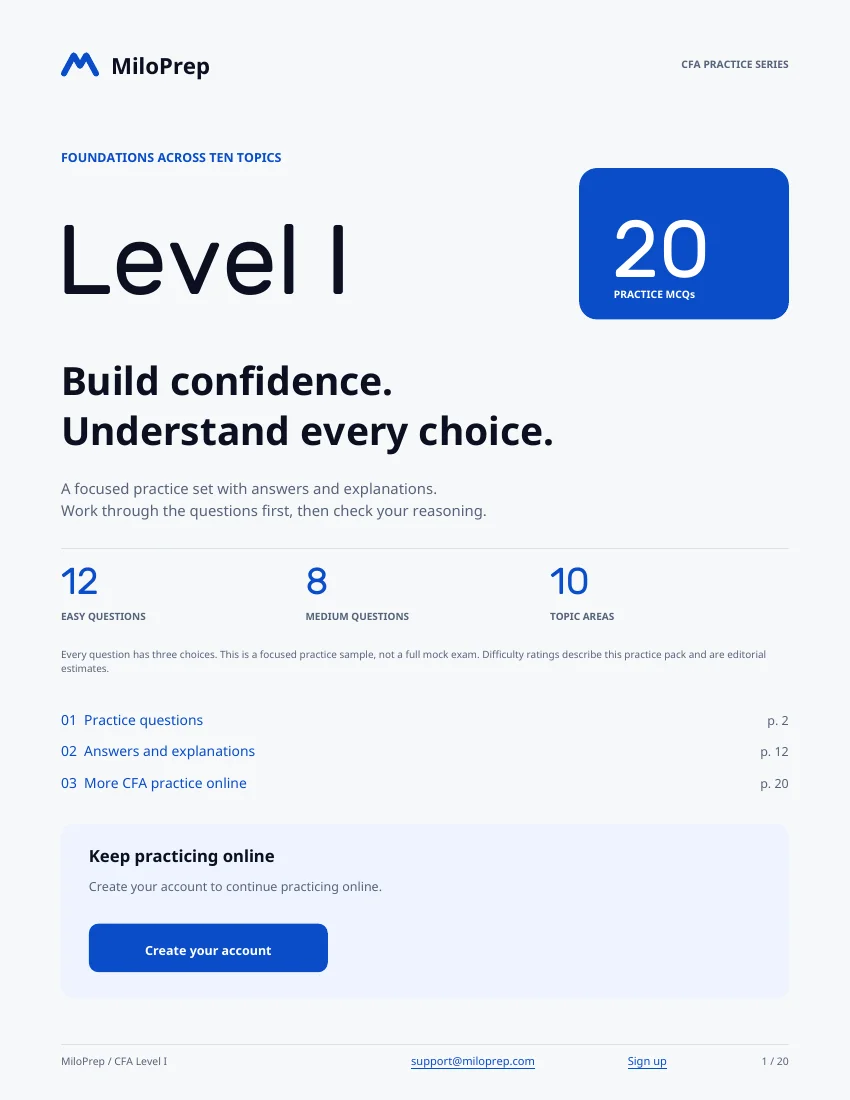
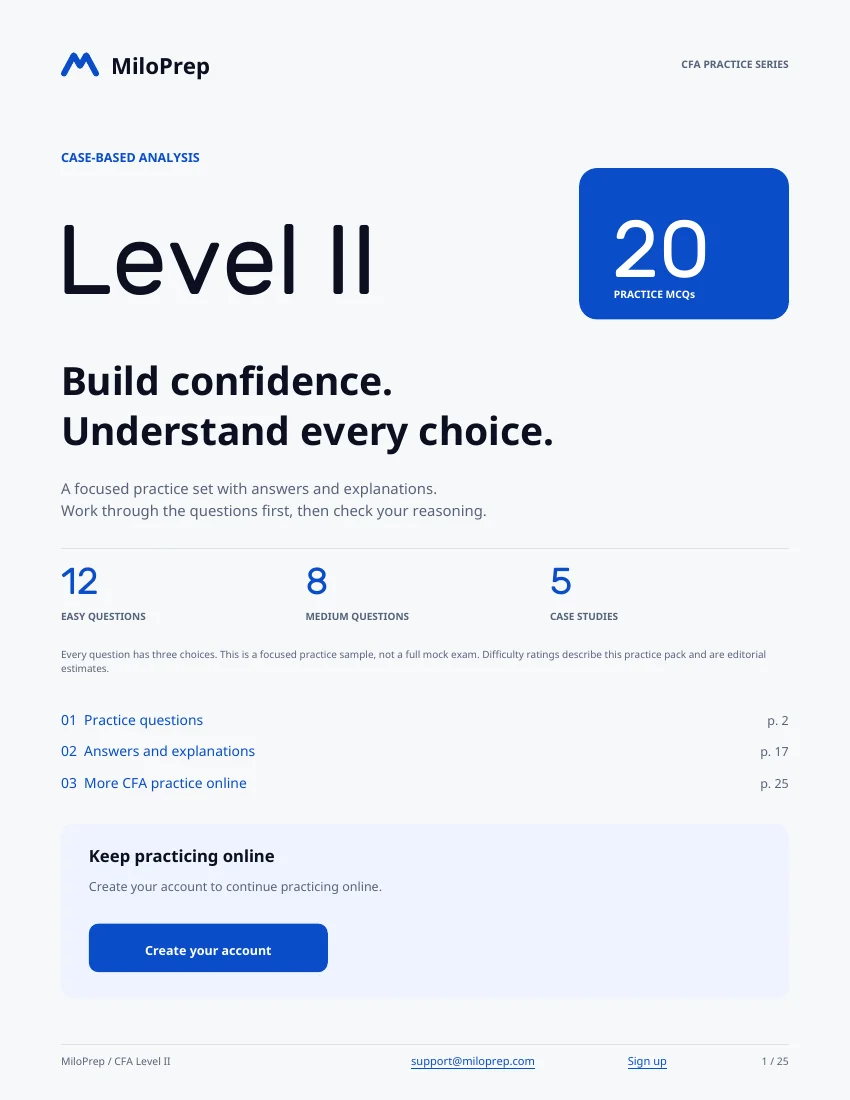
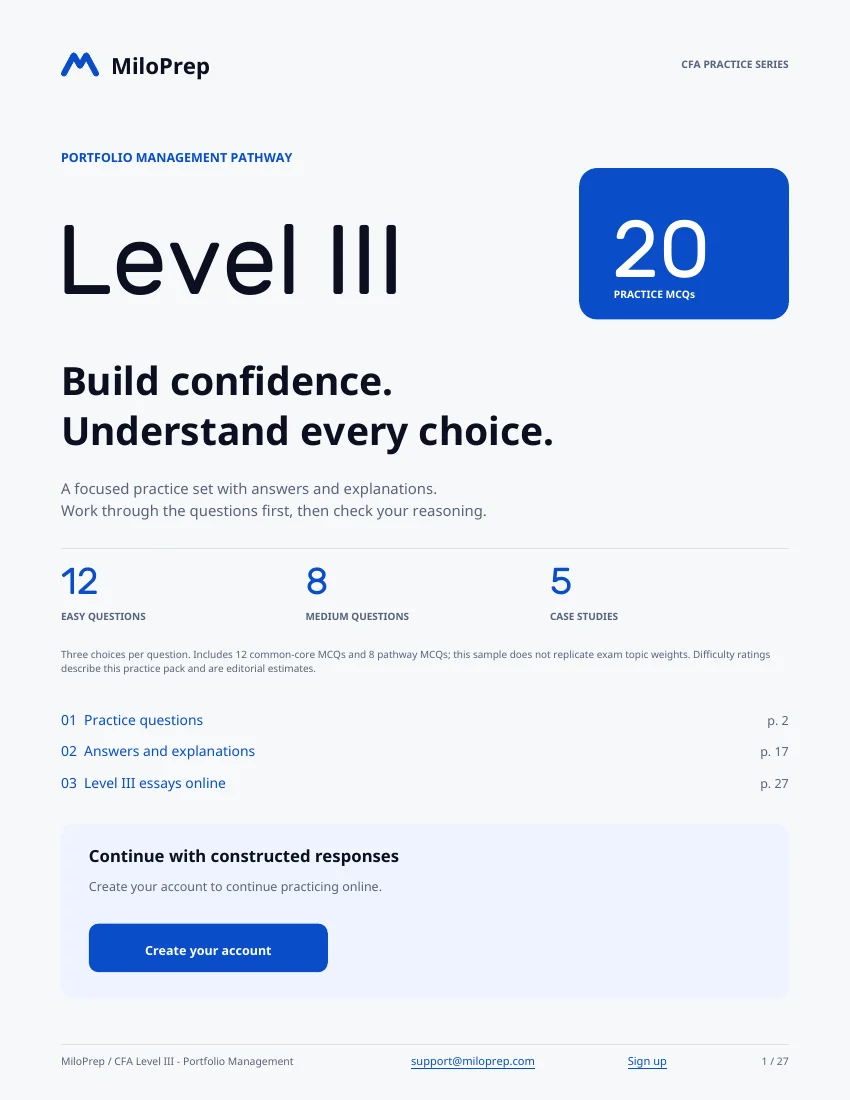
Free PDF by email
All 5 CFA practice PDFs, in one email
Enter your email on the PDF page to receive all 5 printable packs, with answers and explanations. Selected level/pathway questions; see the topic mix before requesting.
No account or payment required for the PDFs. Includes the monthly newsletter; unsubscribe anytime.
Level III topic map
Published weight ranges guide coverage; they are not a forecast of the questions on your sitting. Use the outline for your exam year.
Curriculum weight ranges
Where each topic sits in the exam
Ethical and Professional Standards
10-15%Selected Level III pathway
30-35%Asset Allocation
15-20%Portfolio Construction
15-20%Performance Measurement
5-10%Derivatives and Risk Management
10-15%
Every row uses the same 0-40% scale. A bar marks the minimum-to-maximum interval, not an exact allocation. Match the year to your sitting.
| Topic | Published weight |
|---|---|
| Ethical and Professional Standards | 10-15% |
| Specialised Pathway (Portfolio Management, Private Markets, or Private Wealth) | 30-35% |
| Asset Allocation | 15-20% |
| Portfolio Construction | 15-20% |
| Performance Measurement | 5-10% |
| Derivatives and Risk Management | 10-15% |
Ethical and Professional Standards
- 10-15%
Specialised Pathway (Portfolio Management, Private Markets, or Private Wealth)
- 30-35%
Asset Allocation
- 15-20%
Portfolio Construction
- 15-20%
Performance Measurement
- 5-10%
Derivatives and Risk Management
- 10-15%
Try it here - no account needed
Your 10-question sample
The same ten common-core prompts as Level III practice: five MCQs and five written responses. Writing is self-reviewed, not graded; this is not an exam score.
Progress is kept in this tab when browser storage is available. Responses are not sent to a server.
Completed
0 / 10
MCQ correct / answered
0 / 0
Written responses reviewed
0
Completion is not an exam score. Written responses are self-reviewed, not automatically graded.
- Question 1 of 10Level III previewAsset allocationMultiple choice
Case facts
A foundation holds 60% equities returning 7% and 40% bonds returning 3% in its forecast. Ignore fees and cash flows.
Calculate the forecast portfolio return.
Answer and explanations
Weight each asset return by its allocation: 0.60 x 7% + 0.40 x 3% = 5.4%.
- A: 4.6% reverses the weights.
- B - correct: Weight each asset return by its allocation: 0.60 x 7% + 0.40 x 3% = 5.4%.
- C: 6% is not the weighted average.
- Question 2 of 10Level III previewLiquidity constraintsWritten response
Case facts
A foundation has $10m in assets, including $3m in a fund locked for five years. It owes a $2m grant in six months and proposes another $6m illiquid investment funded in full today. Assume no other inflows before the grant.
Identify the binding constraint and explain why the proposed investment is unsuitable without a funding plan.
Model answer and self-review rubric
Liquidity is the immediate constraint. Existing and proposed illiquid allocations would leave only $1m liquid against a $2m near-term grant, before other expenses. Reserve or arrange reliable funding before investing.
Teaching checklist only. No official points or automated grade.
- Question 3 of 10Level III previewPerformance measurementMultiple choice
Case facts
A manager earns 7.5% against a 6.0% benchmark with 3.0% annualized tracking error. All inputs use the same annual horizon.
Calculate the information ratio.
Answer and explanations
Active return is 1.5 percentage points. Divide by tracking error: (7.5% - 6.0%) / 3.0% = 0.5.
- A - correct: Active return is 1.5 percentage points. Divide by tracking error: (7.5% - 6.0%) / 3.0% = 0.5.
- B: 2.0 divides benchmark return by tracking error.
- C: 2.5 divides total manager return by tracking error.
- Question 4 of 10Level III previewCurrency riskWritten response
Case facts
A USD-based investor owns EUR-denominated bonds. She expects to receive EUR 1m in three months and wants to lock its USD value; assume the receivable is certain.
State the forward position and explain the exposure it offsets.
Model answer and self-review rubric
Sell EUR 1m forward and buy USD for the settlement date. The receivable loses USD value if EUR weakens; the short-EUR forward offsets that currency exposure, subject to counterparty and settlement risk.
Teaching checklist only. No official points or automated grade.
- Question 5 of 10Level III previewOptions and risk managementMultiple choice
Case facts
An investor owns a stock and buys a put on the same stock with strike $50. Ignore the premium when calculating expiration position value.
If the stock ends at $42, what is the combined value of one share and one put?
Answer and explanations
The put pays $8 when the stock is below its $50 strike. Combined value is $42 + $8 = $50, before the ignored premium.
- A: $42 ignores the $8 put payoff.
- B - correct: The put pays $8 when the stock is below its $50 strike. Combined value is $42 + $8 = $50, before the ignored premium.
- C: $58 double-counts protection; the put pays only $8.
- Question 6 of 10Level III previewManager selectionWritten response
Case facts
Two managers earned 9%. Manager A used leverage and held concentrated small-cap stocks; Manager B followed an unlevered broad-market mandate.
Give two reasons the identical return is insufficient to choose a manager.
Model answer and self-review rubric
Compare each manager with an appropriate mandate-specific benchmark and evaluate the risk used to earn the return. Leverage and concentration can create very different downside exposures even when one-period returns match.
Teaching checklist only. No official points or automated grade.
- Question 7 of 10Level III previewRebalancingMultiple choice
Case facts
A policy targets 50% equities with a permitted range of 45%-55%. Equity weight reaches 57%; there are no restrictions or transaction-cost exceptions.
Under this range policy, what triggers review and rebalancing?
Answer and explanations
The equity weight of 57% exceeds the 55% upper bound, so the stated range policy is triggered.
- A - correct: The equity weight of 57% exceeds the 55% upper bound, so the stated range policy is triggered.
- B: A range trigger is not limited to calendar dates.
- C: Coupon timing is not the stated trigger.
- Question 8 of 10Level III previewEthicsWritten response
Case facts
An analyst learns material, nonpublic takeover information from a company director. A client asks the analyst to buy the target immediately.
State the appropriate trading decision and one next step.
Model answer and self-review rubric
Do not trade or cause clients to trade on the information. Follow the firm compliance process, which may include restrictions and escalation, until the information is public or no longer material.
Teaching checklist only. No official points or automated grade.
- Question 9 of 10Level III previewRisk budgetingMultiple choice
Case facts
Two assets have the same standalone volatility but different correlations with an existing portfolio. The manager wants to assess the risk added by a small position.
Which information matters most in addition to standalone volatility?
Answer and explanations
Covariance determines how an added position changes portfolio variance.
- A: A label is not a measure of marginal risk.
- B - correct: Covariance determines how an added position changes portfolio variance.
- C: Price alone does not describe co-movement or position risk.
- Question 10 of 10Level III previewPerformance attributionWritten response
Case facts
Equities return 10% and bonds 2%. A portfolio weights equities at 60%, versus 50% in its benchmark. Within each asset class, portfolio and benchmark returns are identical.
Calculate the portfolio and benchmark returns, then attribute the active return to allocation or selection.
Model answer and self-review rubric
The portfolio earns 6.8%; the benchmark earns 6.0%. The 0.8 percentage-point active return comes from allocating more to the outperforming equity asset class. There is no within-class selection effect in this example.
Teaching checklist only. No official points or automated grade.
Three pathways, one choice
All three share the common core. The specialized pathway has a published 30-35% exam weight.
Portfolio Management
Portfolio implementation, investment strategies and managing portfolios for investors.
Private Markets
Private investments, transaction analysis and the investment lifecycle.
Private Wealth
Wealth planning and investment decisions for individuals and families.
How preparation changes at Level III
Independent study guidance, not an official timetable or a prediction of passing.
Practise both response formats
Use item sets and written responses each week. A strong MCQ score alone does not demonstrate concise written reasoning.
Answer the command word
For a justification, state the decision and the case fact supporting it. Supply exactly the number of reasons requested.
Study your registered pathway
Keep the common core and your selected pathway on the plan. Do not substitute another pathway’s content because it feels familiar.
Build a plan you can actually complete
Choose the correct curriculum
Check the year and, for Level III, the pathway before buying material or reusing old notes.
Separate learning from rehearsal
Reserve sessions for new content, missed-question review and timed mixed practice. Use the linked level-specific plan for a weekly schedule.
Finish the PSM requirement
Account for the Practical Skills Module separately from exam preparation. Check its completion requirements in your candidate account.
What a concise Level III written answer looks like
Original illustration: a portfolio must fund a known payment in three months. A proposed private investment locks up capital for seven years. The prompt asks for one reason to reject funding the payment reserve with that investment.
| Response | Example | Assessment |
|---|---|---|
| Too general | Private investments can be risky. | Does not connect the recommendation to the stated liability. |
| Case-specific | Reject using the reserve because the seven-year lockup prevents reliable access to funds for the payment due in three months. | Gives the decision and one relevant reason tied to both time horizons. |
| Unnecessary addition | The investment may have attractive long-term returns. | Does not resolve the near-term liquidity mismatch. |
Too general
- Example
- Private investments can be risky.
- Assessment
- Does not connect the recommendation to the stated liability.
Case-specific
- Example
- Reject using the reserve because the seven-year lockup prevents reliable access to funds for the payment due in three months.
- Assessment
- Gives the decision and one relevant reason tied to both time horizons.
Unnecessary addition
- Example
- The investment may have attractive long-term returns.
- Assessment
- Does not resolve the near-term liquidity mismatch.
Choose the resource for the task
| Your question | Use | What it gives you |
|---|---|---|
| What is covered? | The topic map above and your exam-year official outline | A coverage checklist rather than a prediction of the next exam. |
| Can I apply a method? | The level-specific practice page | Questions, explanations and mistakes to review. |
| How do I organize my weeks? | The level-specific study plan linked below | A schedule you can adapt to your available hours. |
| What should I bring or book? | CFA Institute candidate resources and your candidate account | Current scheduling, identification and exam-day requirements. |
What is covered?
- Use
- The topic map above and your exam-year official outline
- What it gives you
- A coverage checklist rather than a prediction of the next exam.
Can I apply a method?
- Use
- The level-specific practice page
- What it gives you
- Questions, explanations and mistakes to review.
How do I organize my weeks?
- Use
- The level-specific study plan linked below
- What it gives you
- A schedule you can adapt to your available hours.
What should I bring or book?
- Use
- CFA Institute candidate resources and your candidate account
- What it gives you
- Current scheduling, identification and exam-day requirements.
What you actually need to do in each topic
Use these original practice prompts to turn the topic map into observable skills. They illustrate selected tasks, rather than replacing the exam-year learning outcome statements.
| Topic | Skill to practise | A useful self-check |
|---|---|---|
| Asset allocation | Turn objectives, liabilities and risk capacity into a feasible allocation. | Explain which constraint rules out an attractive expected-return proposal. |
| Portfolio construction | Connect mandates, implementation choices and investor circumstances. | Compare the after-cost decision and the portfolio’s ability to fund cash needs. |
| Performance measurement | Separate return measurement, attribution and evaluation. | Explain a contribution to active return without treating one period as proof of skill. |
| Derivatives and risk management | Choose a hedge or exposure adjustment, then quantify its direction and size. | State what the hedge changes and what basis, curve or implementation risk remains. |
| Ethics | Apply professional duties to the decisions and communications in the case. | Distinguish supporting evidence from a persuasive but unsupported performance claim. |
| Selected pathway | Apply specialized knowledge in Portfolio Management, Private Markets or Private Wealth. | Use your registered pathway’s current learning outcomes and practise both response formats. |
Asset allocation
- Skill to practise
- Turn objectives, liabilities and risk capacity into a feasible allocation.
- A useful self-check
- Explain which constraint rules out an attractive expected-return proposal.
Portfolio construction
- Skill to practise
- Connect mandates, implementation choices and investor circumstances.
- A useful self-check
- Compare the after-cost decision and the portfolio’s ability to fund cash needs.
Performance measurement
- Skill to practise
- Separate return measurement, attribution and evaluation.
- A useful self-check
- Explain a contribution to active return without treating one period as proof of skill.
Derivatives and risk management
- Skill to practise
- Choose a hedge or exposure adjustment, then quantify its direction and size.
- A useful self-check
- State what the hedge changes and what basis, curve or implementation risk remains.
Ethics
- Skill to practise
- Apply professional duties to the decisions and communications in the case.
- A useful self-check
- Distinguish supporting evidence from a persuasive but unsupported performance claim.
Selected pathway
- Skill to practise
- Apply specialized knowledge in Portfolio Management, Private Markets or Private Wealth.
- A useful self-check
- Use your registered pathway’s current learning outcomes and practise both response formats.
How to judge difficulty without relying on a pass-rate headline
An answer must be feasible
A portfolio with the highest expected return may violate liquidity, leverage or policy limits. Write the binding constraint before comparing alternatives. A recommendation should explain how it fits the investor in the case, not an investor you imagine.
Writing exposes incomplete reasoning
In a justification, state a decision and a relevant supporting fact. A list of definitions can be accurate yet fail to answer the question. If two reasons are requested, check that they are distinct rather than the same point written twice.
Pathway knowledge is additional work
Common-core familiarity does not establish readiness for the selected pathway. Keep a separate coverage list and attempt fresh pathway questions. Review whether a weak answer reflects missing specialized knowledge or difficulty expressing a known decision.
Registration, results and preparation: the short answers
| Question | Answer | Next action |
|---|---|---|
| Is registering the same as booking an appointment? | No. Registration and scheduling the test-center appointment are separate steps. | Use the candidate account to confirm both the window and the appointment. |
| How many hours should I plan? | CFA Institute reports successful candidates average over 300 preparation hours per level. This is a reported average, not a requirement or a guarantee. | Estimate your own gaps and available hours; use the dedicated study plan for the weekly schedule. |
| Does the PSM fit inside that estimate? | Keep the required Practical Skills Module visible as a separate task in your preparation budget. | Check the module and completion deadline in your candidate account. |
| Where should I get dates and fees? | Use the current official registration calendar for the level and window you intend to enter. | Follow the dates resource below and verify the amount before registering. |
| What does a pass establish? | It completes the final exam stage; experience and membership requirements still matter for the charter. | Check the remaining program and membership milestones. |
Is registering the same as booking an appointment?
- Answer
- No. Registration and scheduling the test-center appointment are separate steps.
- Next action
- Use the candidate account to confirm both the window and the appointment.
How many hours should I plan?
- Answer
- CFA Institute reports successful candidates average over 300 preparation hours per level. This is a reported average, not a requirement or a guarantee.
- Next action
- Estimate your own gaps and available hours; use the dedicated study plan for the weekly schedule.
Does the PSM fit inside that estimate?
- Answer
- Keep the required Practical Skills Module visible as a separate task in your preparation budget.
- Next action
- Check the module and completion deadline in your candidate account.
Where should I get dates and fees?
- Answer
- Use the current official registration calendar for the level and window you intend to enter.
- Next action
- Follow the dates resource below and verify the amount before registering.
What does a pass establish?
- Answer
- It completes the final exam stage; experience and membership requirements still matter for the charter.
- Next action
- Check the remaining program and membership milestones.
Quick answers
- How long is the CFA Level III exam?
- There are two 132-minute sessions. The optional break and check-in are additional.
- Does Level III still have multiple-choice questions?
- Yes. It combines 11 item sets with 11 constructed-response sets across the two sessions.
- Is this a complete course or a full mock exam?
- No. This is an orientation guide. Use the official curriculum for coverage, the topic lessons for selected methods, and timed practice for rehearsal.
Ready to try a few questions?
Free PDF by email
All 5 CFA practice PDFs, in one email
Enter your email on the PDF page to receive all 5 printable packs, with answers and explanations. Selected level/pathway questions; see the topic mix before requesting.
No account or payment required for the PDFs. Includes the monthly newsletter; unsubscribe anytime.
PDF delivery requires email and includes the monthly newsletter. Unsubscribe anytime.
Notes
- * Level III at a glance: Exam time excludes check-in and the optional break. Complete the required Practical Skills Module to receive your result. ↩ Return to content