CFA Level III practice questions
Start with the free MCQ samples below. For complete Level III preparation, combine item sets with written responses in the common core and your selected pathway.

Know what you are practising*
| Scope | This page | Official exam |
|---|---|---|
| Question format | MCQs and written-response learning examples | 11 item sets + 11 constructed-response sets |
Question format
- This page
- MCQs and written-response learning examples
- Official exam
- 11 item sets + 11 constructed-response sets
Try it here - no account needed
Your 10-question sample
2026 common-core learning sample. Written-response checklists are independent teaching rubrics, not official points or an automated CFA grade.
Progress is kept in this tab when browser storage is available. Responses are not sent to a server.
Completed
0 / 10
MCQ correct / answered
0 / 0
Written responses reviewed
0
Completion is not an exam score. Written responses are self-reviewed, not automatically graded.
- Question 1 of 10Asset allocationMultiple choice
Case facts
A foundation holds 60% equities returning 7% and 40% bonds returning 3% in its forecast. Ignore fees and cash flows.
Calculate the forecast portfolio return.
Answer and explanations
Weight each asset return by its allocation: 0.60 x 7% + 0.40 x 3% = 5.4%.
- A: 4.6% reverses the weights.
- B - correct: Weight each asset return by its allocation: 0.60 x 7% + 0.40 x 3% = 5.4%.
- C: 6% is not the weighted average.
- Question 2 of 10Liquidity constraintsWritten response
Case facts
A foundation has $10m in assets, including $3m in a fund locked for five years. It owes a $2m grant in six months and proposes another $6m illiquid investment funded in full today. Assume no other inflows before the grant.
Identify the binding constraint and explain why the proposed investment is unsuitable without a funding plan.
Model answer and self-review rubric
Liquidity is the immediate constraint. Existing and proposed illiquid allocations would leave only $1m liquid against a $2m near-term grant, before other expenses. Reserve or arrange reliable funding before investing.
Teaching checklist only. No official points or automated grade.
- Question 3 of 10Performance measurementMultiple choice
Case facts
A manager earns 7.5% against a 6.0% benchmark with 3.0% annualized tracking error. All inputs use the same annual horizon.
Calculate the information ratio.
Answer and explanations
Active return is 1.5 percentage points. Divide by tracking error: (7.5% - 6.0%) / 3.0% = 0.5.
- A - correct: Active return is 1.5 percentage points. Divide by tracking error: (7.5% - 6.0%) / 3.0% = 0.5.
- B: 2.0 divides benchmark return by tracking error.
- C: 2.5 divides total manager return by tracking error.
- Question 4 of 10Currency riskWritten response
Case facts
A USD-based investor owns EUR-denominated bonds. She expects to receive EUR 1m in three months and wants to lock its USD value; assume the receivable is certain.
State the forward position and explain the exposure it offsets.
Model answer and self-review rubric
Sell EUR 1m forward and buy USD for the settlement date. The receivable loses USD value if EUR weakens; the short-EUR forward offsets that currency exposure, subject to counterparty and settlement risk.
Teaching checklist only. No official points or automated grade.
- Question 5 of 10Options and risk managementMultiple choice
Case facts
An investor owns a stock and buys a put on the same stock with strike $50. Ignore the premium when calculating expiration position value.
If the stock ends at $42, what is the combined value of one share and one put?
Answer and explanations
The put pays $8 when the stock is below its $50 strike. Combined value is $42 + $8 = $50, before the ignored premium.
- A: $42 ignores the $8 put payoff.
- B - correct: The put pays $8 when the stock is below its $50 strike. Combined value is $42 + $8 = $50, before the ignored premium.
- C: $58 double-counts protection; the put pays only $8.
- Question 6 of 10Manager selectionWritten response
Case facts
Two managers earned 9%. Manager A used leverage and held concentrated small-cap stocks; Manager B followed an unlevered broad-market mandate.
Give two reasons the identical return is insufficient to choose a manager.
Model answer and self-review rubric
Compare each manager with an appropriate mandate-specific benchmark and evaluate the risk used to earn the return. Leverage and concentration can create very different downside exposures even when one-period returns match.
Teaching checklist only. No official points or automated grade.
- Question 7 of 10RebalancingMultiple choice
Case facts
A policy targets 50% equities with a permitted range of 45%-55%. Equity weight reaches 57%; there are no restrictions or transaction-cost exceptions.
Under this range policy, what triggers review and rebalancing?
Answer and explanations
The equity weight of 57% exceeds the 55% upper bound, so the stated range policy is triggered.
- A - correct: The equity weight of 57% exceeds the 55% upper bound, so the stated range policy is triggered.
- B: A range trigger is not limited to calendar dates.
- C: Coupon timing is not the stated trigger.
- Question 8 of 10EthicsWritten response
Case facts
An analyst learns material, nonpublic takeover information from a company director. A client asks the analyst to buy the target immediately.
State the appropriate trading decision and one next step.
Model answer and self-review rubric
Do not trade or cause clients to trade on the information. Follow the firm compliance process, which may include restrictions and escalation, until the information is public or no longer material.
Teaching checklist only. No official points or automated grade.
- Question 9 of 10Risk budgetingMultiple choice
Case facts
Two assets have the same standalone volatility but different correlations with an existing portfolio. The manager wants to assess the risk added by a small position.
Which information matters most in addition to standalone volatility?
Answer and explanations
Covariance determines how an added position changes portfolio variance.
- A: A label is not a measure of marginal risk.
- B - correct: Covariance determines how an added position changes portfolio variance.
- C: Price alone does not describe co-movement or position risk.
- Question 10 of 10Performance attributionWritten response
Case facts
Equities return 10% and bonds 2%. A portfolio weights equities at 60%, versus 50% in its benchmark. Within each asset class, portfolio and benchmark returns are identical.
Calculate the portfolio and benchmark returns, then attribute the active return to allocation or selection.
Model answer and self-review rubric
The portfolio earns 6.8%; the benchmark earns 6.0%. The 0.8 percentage-point active return comes from allocating more to the outperforming equity asset class. There is no within-class selection effect in this example.
Teaching checklist only. No official points or automated grade.
No account required
Try 20 questions across 5 cases
Read each case, attempt its four questions, then check the explanations. These original teaching cases cover selected skills and are not a full mock or an official item set.
4 questions per case
Case 1 · Four questions
Portfolio objectives and liquidity
A fictional client has a USD 800,000 portfolio and must pay USD 80,000 in three months from that portfolio. The investment policy permits at most 60% in equities and prohibits borrowing. A proposed portfolio holds 60% equities and 40% bonds, with assumed annual expected returns of 8% and 3% respectively. For return calculations, ignore fees, taxes and cash flows.
Proposed portfolio
60% equities40% bonds
Weights supplied by this fictional case. These bars do not represent returns or a portfolio recommendation.
Portfolio construction: liquidity
The known payment represents what proportion of the current portfolio?
Asset allocation: expected return
The proposed 60/40 portfolio’s expected annual return is:
Performance measurement: active return
In a separate measurement period, portfolio return is 6.5% and benchmark return is 6.0%. Arithmetic active return is:
Portfolio construction: respect constraints
Which proposed action directly violates the stated policy?
Written-response example
Explain why the expected 6% annual portfolio return is insufficient, by itself, to establish that the three-month payment can be met.
The USD 80,000 payment is due in three months, while 6% is an uncertain annual expected return. The portfolio needs sufficient liquid resources for the payment without relying on that return or borrowing, which the policy prohibits.
- Identify the three-month payment and timing mismatch.
- Distinguish an expected return from cash available when due.
- Use the no-borrowing constraint instead of proposing leverage.
Independent learning example, not an official scoring rubric.
Case 2 · Four questions
Reduce interest-rate exposure with futures
A fictional USD 10 million bond portfolio has modified duration 6. Its manager wants duration 4 without selling the bonds. A long futures contract has dollar duration per basis point (DV01) of USD 80. Assume the contract and portfolio respond to the same parallel rate change, the supplied futures DV01 includes the relevant contract conversion, and convexity and transaction costs can be ignored.
Derivatives: hedge direction
To reduce the portfolio’s rate exposure, the manager should:
Derivatives: hedge size
The required number of futures contracts is:
Portfolio risk: interpret the hedge
For a 25-basis-point parallel rate increase, the hedged portfolio’s approximate value change is:
Portfolio risk: limitations of a duration hedge
Which departure from the assumptions can make actual hedge performance differ from the duration estimate?
Written-response example
Justify selling futures rather than buying them, and identify one limitation of the calculation.
Sell futures to add negative duration and reduce the bond portfolio’s positive rate exposure from 6 toward 4. The calculation assumes matched parallel moves, so curve-shape or basis changes can leave a different residual exposure.
- Link the short direction to the lower target duration.
- Name one risk outside the stated parallel-shift assumption.
Independent learning example, not an official scoring rubric.
Case 3 · Four questions
Explain active return, not only total return
For one measurement period, a fictional portfolio holds 60% equities and 40% bonds, returning 10% and 2% in those segments. Its benchmark holds 50% in each segment, whose benchmark returns are 8% and 3%. Weights are beginning-of-period weights. Ignore fees, cash flows and compounding within the period. For the allocation effect, use the Brinson-Fachler formula: sum of (portfolio weight - benchmark weight) × (segment benchmark return - total benchmark return).
Portfolio
60% equities40% bondsBenchmark
50% equities50% bonds
Weights supplied by this fictional case. These bars do not represent returns or a portfolio recommendation.
Performance measurement: portfolio return
The portfolio return is:
Performance measurement: benchmark return
The benchmark return is:
Performance measurement: active return
The portfolio’s arithmetic active return is:
Performance attribution: allocation effect
The total allocation effect under the stated formula is:
Case 4 · Four questions
Rebalance within a portfolio mandate
A fictional USD 5 million portfolio currently holds 70% equities and 30% bonds. Its policy target is 60% equities and 40% bonds, with rebalancing required when equity weight exceeds 65%. Assume no taxes, external cash flows or market changes during execution. Selling equities costs 0.10% of equity sale proceeds. For this exercise, compute the trade to reach the target before transaction costs, then calculate that cost separately. A client asks whether expected equity outperformance permits ignoring the policy.
Portfolio construction: rebalancing rule
The current equity allocation requires:
Portfolio construction: trade size
The equity sale needed to reach 60% before costs is:
Portfolio construction: implementation cost
The equity-sale transaction cost is:
Portfolio construction: mandate discipline
The manager should most appropriately respond to the client’s expected-return argument by:
Written-response example
Justify rebalancing even if the manager expects equities to outperform bonds.
Equities are 70% of the portfolio, above the policy’s 65% trigger. Rebalancing restores exposure toward the authorized 60% target; an uncertain return forecast does not remove that mandate.
- Use the observed 70% weight and 65% trigger.
- Connect the trade to the authorized target, rather than claiming certain future returns.
Independent learning example, not an official scoring rubric.
Case 5 · Four questions
Performance communication and client interests
A fictional portfolio manager bound by the CFA Institute Code and Standards prepares a client presentation. One portfolio returned 12% last year before fees; comparable portfolio outcomes varied. A draft slide calls 12% a guaranteed future return. A client offers the manager a bonus for outperformance in addition to employer pay, and the manager has not obtained written consent from the employer. Another employee proposes allocating a scarce attractive investment to the manager’s personal account before suitable client accounts.
Ethics: performance presentation
The manager should most appropriately revise the 12% slide to:
Ethics: additional compensation
Before accepting the client’s additional performance bonus, the manager should:
Ethics: priority of transactions
The proposed personal allocation ahead of suitable client accounts is most appropriately:
Ethics: interpreting track records
Which conclusion is supported by the supplied performance evidence alone?
Written-response example
Identify two separate reasons why the original performance slide could mislead a prospective client.
It treats a historical 12% result as a guaranteed future outcome. It also presents one portfolio’s before-fee result without the context that comparable outcomes varied, which can imply a representative experience that the evidence does not establish.
- Separate the future guarantee from the representativeness issue.
- Use the supplied facts and identify the fee basis.
- Do not invent a required composite or claim GIPS compliance from this case.
Independent learning example, not an official scoring rubric.
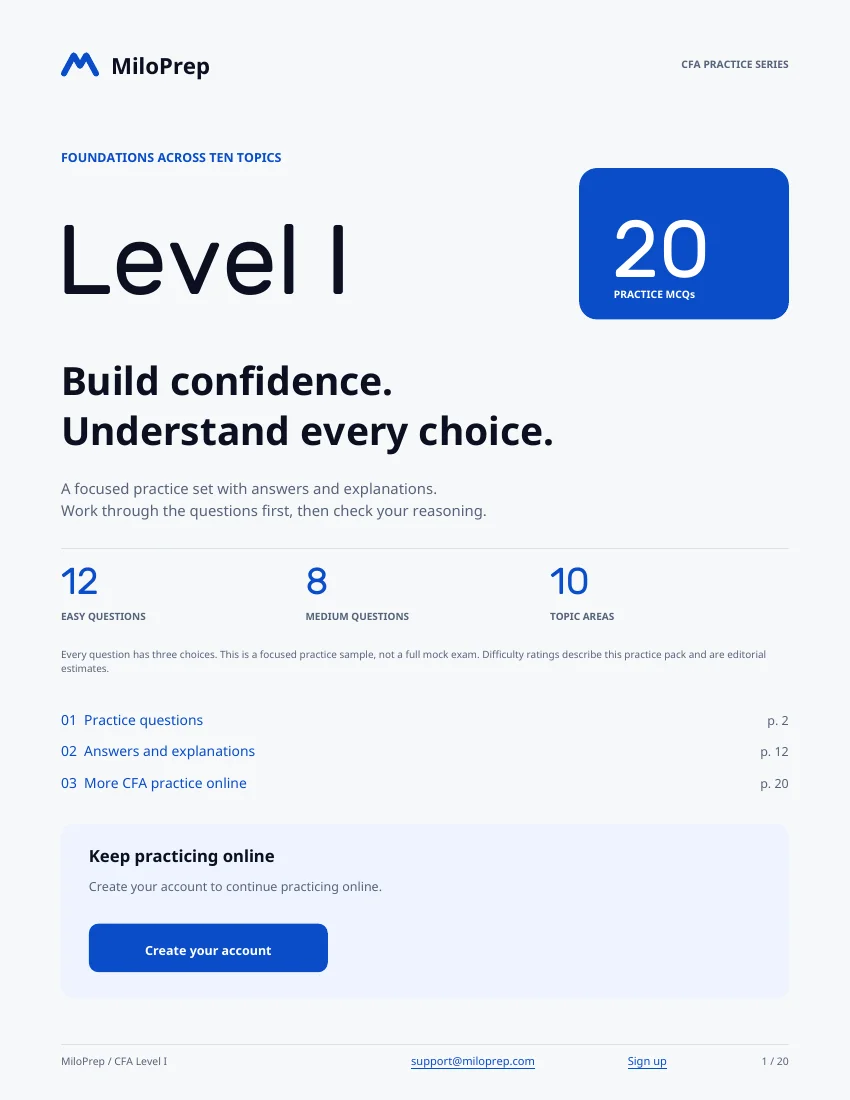

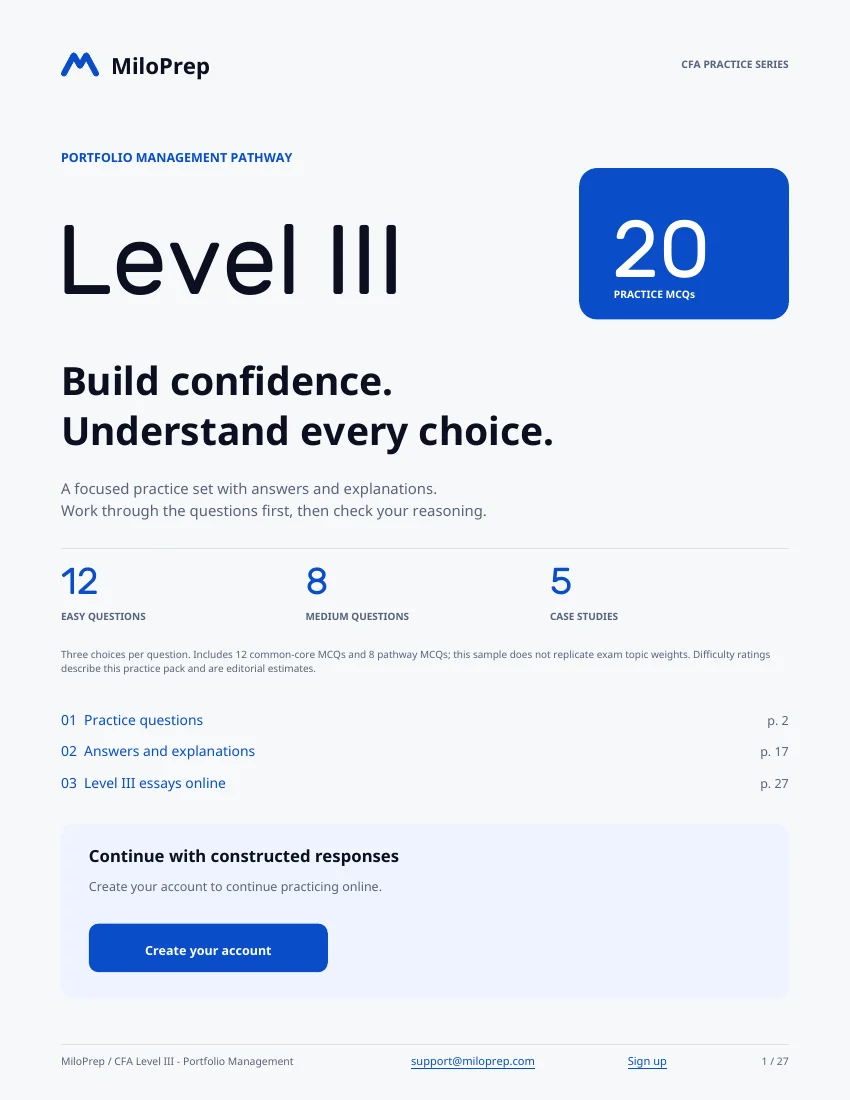
Free PDF by email
All 5 CFA practice PDFs, in one email
Enter your email on the PDF page to receive all 5 printable packs, with answers and explanations. Selected level/pathway questions; see the topic mix before requesting.
No account or payment required for the PDFs. Includes the monthly newsletter; unsubscribe anytime.
Turn an answer into useful practice
Independent study guidance, not an official timetable or a prediction of passing.
Attempt before revealing
Choose an answer and write down the rule or case fact you relied on.
Explain the mistake
For MCQs, check the decision rule. For written work, check the command word and the case-specific support.
Retest with a fresh item
Use a different question after a delay. Track whether the reasoning transfers instead of memorizing the answer letter.
Read the explanation as a reasoning check
| If you... | Check this | Next attempt |
|---|---|---|
| Chose the right answer by guessing | Can you identify the rule and the deciding case fact? | Explain the answer without relying on the letter or remembered number. |
| Selected the wrong input | Did the date, unit, exhibit or cash-flow definition match the question? | Label each input before calculating. |
| Used the wrong model | Which assumption makes the chosen method appropriate? | Change one assumption and decide whether the method still fits. |
| Made an arithmetic error | Were the formula, signs and periods correct before calculator entry? | Estimate direction and approximate size, then recalculate. |
Chose the right answer by guessing
- Check this
- Can you identify the rule and the deciding case fact?
- Next attempt
- Explain the answer without relying on the letter or remembered number.
Selected the wrong input
- Check this
- Did the date, unit, exhibit or cash-flow definition match the question?
- Next attempt
- Label each input before calculating.
Used the wrong model
- Check this
- Which assumption makes the chosen method appropriate?
- Next attempt
- Change one assumption and decide whether the method still fits.
Made an arithmetic error
- Check this
- Were the formula, signs and periods correct before calculator entry?
- Next attempt
- Estimate direction and approximate size, then recalculate.
Move from a teaching sample to exam rehearsal
Learn from the cases first
These short original cases isolate selected skills. Work through the explanation and understand each distractor before increasing speed. The sample distribution is not the official topic weighting.
Broaden to your current outline
Keep a checklist of the current learning outcomes and practise uncovered material using the official curriculum and appropriate question sets. Several correct answers on a selected method do not establish coverage of the topic.
Use a complete mock for rehearsal
A full session tests pacing, switching topics and maintaining attention. Review those observations as well as the questions. For Level III, include both written responses and the registered pathway; an MCQ-only sample cannot rehearse the whole exam.
Quick answers
- Do I need an account to try the samples?
- No. You can answer the on-page samples without an account. The app and email-delivered PDFs have separate signup steps.
- Can I use these questions as a mock exam?
- No. A short sample does not cover the full curriculum or reproduce a complete exam session.
Ready to try a few questions?
Free PDF by email
All 5 CFA practice PDFs, in one email
Enter your email on the PDF page to receive all 5 printable packs, with answers and explanations. Selected level/pathway questions; see the topic mix before requesting.
No account or payment required for the PDFs. Includes the monthly newsletter; unsubscribe anytime.
PDF delivery requires email and includes the monthly newsletter. Unsubscribe anytime.
Notes
- * Know what you are practising: Independent samples, not official exam questions, a complete mock or a readiness score. ↩ Return to content