CFA Level 1 Equity Investments: notes and free practice
CFA Level 1 Equity Investments covers markets, securities and basic equity valuation. Connect the claim held by the investor to expected cash flows, required return and a valuation method that fits the assumptions.
The key ideas, at a glance

Read the trading instruction
Read the visual, then follow the worked example below. Use the stated case assumptions.
Illustrative worked case
$ per share
- Buy limit
- 25
- Available offer
- 26
The $26 offer exceeds the $25 limit. The order need not execute at that offer.
| Concept | Rule or decision | Common mistake |
|---|---|---|
| Read the trading instruction | Price control and execution certainty are different | A market order prioritizes execution, not a guaranteed quoted price. |
| Identify the weighting rule | Index return = Σ beginning weight × constituent return | The higher share price does not necessarily identify the larger company. |
| Match distributions to discount rates | Constant-growth value = D1 / (r - g), with r > g | The formula is not usable with perpetual growth at or above the required return. |
| Check the economic meaning | Price, earnings and growth must refer to compatible measures | A low multiple can reflect weak prospects rather than undervaluation. |
01Read the trading instruction
Price control and execution certainty are different
Watch for: A market order prioritizes execution, not a guaranteed quoted price.
02Identify the weighting rule
Index return = Σ beginning weight × constituent return
Watch for: The higher share price does not necessarily identify the larger company.
03Match distributions to discount rates
Constant-growth value = D1 / (r - g), with r > g
Watch for: The formula is not usable with perpetual growth at or above the required return.
04Check the economic meaning
Price, earnings and growth must refer to compatible measures
Watch for: A low multiple can reflect weak prospects rather than undervaluation.
Selected 2026 study concepts. Match your preparation to your registered exam-year curriculum. These notes are not complete curriculum coverage.
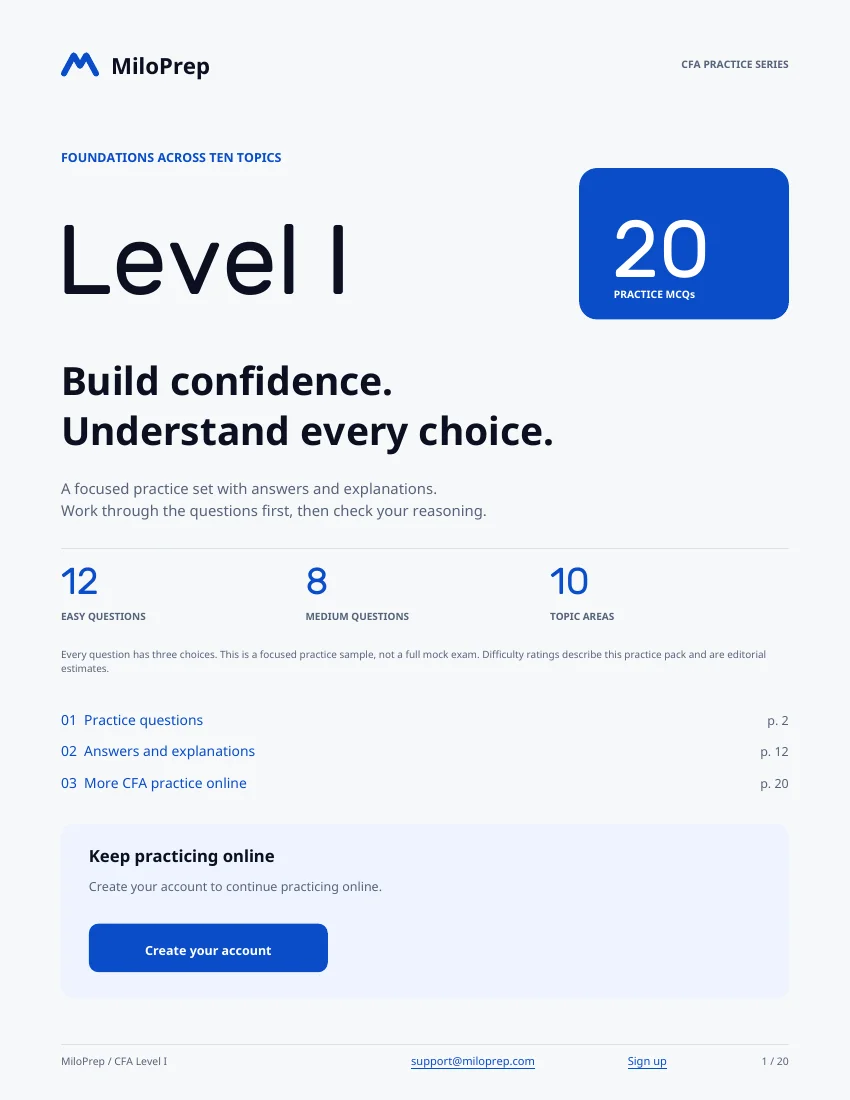
Free PDF by email
CFA Level I: 20 practice MCQs
Enter your email on the PDF page to receive the printable pack, with answers and explanations. Selected level/pathway questions; see the topic mix before requesting.
No account or payment required for the PDFs. Includes the monthly newsletter; unsubscribe anytime.
Put the method to work
One worked example, from facts to answer
Given
A buy limit is $25; the best available offer remains $26.
Method
Compare the offer with the highest permitted purchase price.
Answer and interpretation
The limit order need not execute; it does not authorize a $26 purchase.
Original independent teaching example. Assumptions are stated above; this is not an official exam question or scoring key.
Try it here - no account needed
10 free Equity Investments questions
Choose an answer, check the reasoning, then use ‘Review the method’ to revisit the exact idea. Selected practice, not a complete syllabus or pass prediction.
Saved in this tab when storage is available. Responses are not uploaded.
Completed
0 / 10
MCQ correct
0 / 0
Completion is not an exam score.
- Question 1 of 10Level I topic sampleEquity InvestmentsMultiple choice
An investor buys newly issued shares directly in a company’s capital raising. This transaction is in the:
Answer and explanations
The company issues new securities and receives capital, which is a primary-market transaction.
Review the method- A: Secondary trading transfers existing securities between investors rather than raising this new capital.
- B - correct: The company issues new securities and receives capital, which is a primary-market transaction.
- C: Issuing equity is not exclusively a currency-market transaction.
- Question 2 of 10Level I topic sampleEquity InvestmentsMultiple choice
A buy limit order is set at $18 while the lowest available offer stays at $19. What is correct?
Answer and explanations
The order permits buying at $18 or better but may remain unfilled while offers exceed that level.
Review the method- A - correct: The order permits buying at $18 or better but may remain unfilled while offers exceed that level.
- B: Buying at $19 would exceed the stated limit.
- C: An execution instruction does not guarantee subsequent investment profit.
- Question 3 of 10Level I topic sampleEquity InvestmentsMultiple choice
An investor buys $100 of shares with $50 equity and $50 borrowing. The shares rise to $110 and the debt remains $50. Ignore interest, income and costs. Return on equity is:
Answer and explanations
Ending equity is $110 - $50 = $60; the $10 gain on $50 initial equity is 20%.
Review the method- A: 10% is the return on the gross asset position, not the investor’s $50 equity.
- B: The ending asset amount is not an equity return percentage.
- C - correct: Ending equity is $110 - $50 = $60; the $10 gain on $50 initial equity is 20%.
- Question 4 of 10Level I topic sampleEquity InvestmentsMultiple choice
An index contains companies worth $600m and $400m, with no float adjustments. In a capitalization-weighted index, the larger company’s weight is:
Answer and explanations
$600m / ($600m + $400m) = 60% of combined capitalization.
Review the method- A: 50% would be equal weighting rather than capitalization weighting.
- B - correct: $600m / ($600m + $400m) = 60% of combined capitalization.
- C: 150% divides one company by the other instead of by the total.
- Question 5 of 10Level I topic sampleEquity InvestmentsMultiple choice
A price-return index rises 4% and its constituents distribute dividends during the period. Assuming reinvestment and no offsetting costs, its total return compared with price return is:
Answer and explanations
Total return includes reinvested distributions in addition to price changes.
Review the method- A - correct: Total return includes reinvested distributions in addition to price changes.
- B: Ignoring dividends describes price return, not the reason total return would be lower.
- C: Positive distributions make the measures differ under the stated assumptions.
- Question 6 of 10Level I topic sampleEquity InvestmentsMultiple choice
A non-callable perpetual preferred share pays a fixed $4 annual dividend. At an 8% required return, its value is:
Answer and explanations
$4 / 0.08 = $50 for the stated fixed perpetuity.
Review the method- A: $32 multiplies the wrong quantities instead of capitalizing the annual dividend.
- B: $54 adds a dividend to the capitalized value without justification.
- C - correct: $4 / 0.08 = $50 for the stated fixed perpetuity.
- Question 7 of 10Level I topic sampleEquity InvestmentsMultiple choice
Next year’s dividend is $2.10 and then grows at 2% perpetually. With a 9% required return, the constant-growth value is:
Answer and explanations
$2.10 / (0.09 - 0.02) = $30; the next dividend is already supplied.
Review the method- A: $23.33 divides by 9% while ignoring positive perpetual growth.
- B - correct: $2.10 / (0.09 - 0.02) = $30; the next dividend is already supplied.
- C: $107.10 does not use the required-return-minus-growth denominator.
- Question 8 of 10Level I topic sampleEquity InvestmentsMultiple choice
A share trades at $24 and has trailing EPS of $3. Its trailing price-to-earnings ratio is:
Answer and explanations
$24 / $3 = 8 times trailing earnings per share.
Review the method- A - correct: $24 / $3 = 8 times trailing earnings per share.
- B: 0.125 is earnings yield as a decimal, the reciprocal of P/E.
- C: Multiplying price by earnings does not produce the P/E ratio.
- Question 9 of 10Level I topic sampleEquity InvestmentsMultiple choice
An investor owns 100 shares at $40 each before a two-for-one split. Ignoring market movements, the mechanical post-split holding is:
Answer and explanations
Shares double and price halves, preserving the $4,000 holding value mechanically.
Review the method- A: This halves value by ignoring the additional shares from the split.
- B: Doubling shares without adjusting price incorrectly doubles total value.
- C - correct: Shares double and price halves, preserving the $4,000 holding value mechanically.
- Question 10 of 10Level I topic sampleEquity InvestmentsMultiple choice
In a constant-growth dividend model with positive dividends and r greater than g, what happens if required return rises while the dividend forecast and growth remain unchanged?
Answer and explanations
The denominator r - g increases while the numerator stays fixed, so estimated value falls.
Review the method- A: A higher discount spread lowers, rather than raises, this model’s value.
- B - correct: The denominator r - g increases while the numerator stays fixed, so estimated value falls.
- C: Changing r directly changes the denominator.
Four ideas to put to work
Find the method you need
Start with: Share ownership, percentage returns and discounting future distributions.
METHOD 01
Read the trading instruction
Price control and execution certainty are different
- Distinguish new capital raised from trading between existing holders.
- A limit price restricts execution price but does not guarantee a fill.
- Leverage magnifies gains and losses relative to the investor’s equity.
Worked example
- Given
- A buy limit is $25; the best available offer remains $26.
- Calculate / decide
- Compare the offer with the highest permitted purchase price.
- Result
- The limit order need not execute; it does not authorize a $26 purchase.
Watch for: A market order prioritizes execution, not a guaranteed quoted price.
Practise this ideaMETHOD 02
Identify the weighting rule
Index return = Σ beginning weight × constituent return
- Use market values for a capitalization-weighted example.
- Distinguish price return from total return including distributions.
- Separate rebalancing weights from changing index membership.
Worked example
- Given
- Two firms have market capitalizations of $300m and $100m.
- Calculate / decide
- Divide each capitalization by the combined $400m.
- Result
- Their capitalization weights are 75% and 25% before any float adjustment.
Watch for: The higher share price does not necessarily identify the larger company.
Practise this ideaMETHOD 03
Match distributions to discount rates
Constant-growth value = D1 / (r - g), with r > g
- Use the next dividend D1 in the constant-growth model.
- For a fixed perpetual preferred dividend, value = dividend / required return.
- State assumptions; a model estimate is not an assured sale price.
Worked example
- Given
- Next dividend $2.40, required return 10%, perpetual growth 4%.
- Calculate / decide
- 2.40 / (0.10 - 0.04).
- Result
- Estimated value is $40 under the constant-growth assumptions.
Watch for: The formula is not usable with perpetual growth at or above the required return.
Practise this ideaMETHOD 04
Check the economic meaning
Price, earnings and growth must refer to compatible measures
- Distinguish trailing earnings from forecast earnings in a P/E ratio.
- Compare business risk and accounting choices before using peer multiples.
- A stock split changes share units, not total value mechanically.
Worked example
- Given
- Price is $36 and trailing EPS is $3.
- Calculate / decide
- 36 / 3.
- Result
- Trailing P/E is 12 times; it does not itself prove the share is cheap.
Watch for: A low multiple can reflect weak prospects rather than undervaluation.
Practise this ideaQuestions about this topic
- Are market value and book value the same?
- No. Market value reflects a traded price or valuation, while book value is an accounting amount under the applicable reporting basis. Their difference needs interpretation rather than an assumption that one must equal the other.
- Which dividend goes into a constant-growth dividend model?
- Use the next-period dividend, D1, in D1 / (required return - perpetual growth), with the required return exceeding growth and the model’s assumptions satisfied. A just-paid dividend must first be grown to the next period.
- Does a lower P/E always mean an equity is cheaper?
- No. Growth, risk, accounting, business mix and earnings quality can explain different multiples. Compare like earnings measures and economically comparable companies before drawing the valuation conclusion.
Sources and curriculum scope
Official outlines establish curriculum scope. The explanations and worked examples are independent teaching material; the sources do not verify or endorse them.
- 2026 CFA Level I outline: Equity Investments
- 2026 CFA Level 1 curriculum outline
- 2027 CFA Level 1 curriculum outline
MiloPrep is an independent study resource, not affiliated with or endorsed by CFA Institute. CFA® and Chartered Financial Analyst® are trademarks owned by CFA Institute.