CFA Level 3 essay and constructed-response guide
CFA constructed response means writing a direct answer to a Level III command word. State the decision or calculation, support it with the relevant case facts, and stop when you have answered the request.
What each command word needs*
| Command | Answer shape | Illustrative response |
|---|---|---|
| Identify | Name the requested item | Liquidity risk. |
| Justify | Decision + case-specific reason | Prefer A because its daily liquidity meets the client’s near-term cash need. |
| Calculate | Requested result, with clear units | Portfolio value × target weight = allocation in currency units. |
| Explain | Cause + consequence | A longer duration increases sensitivity to a change in yields. |
Official sources checked 8 October 2026: Level III exam
Swipe the table to see all columns.
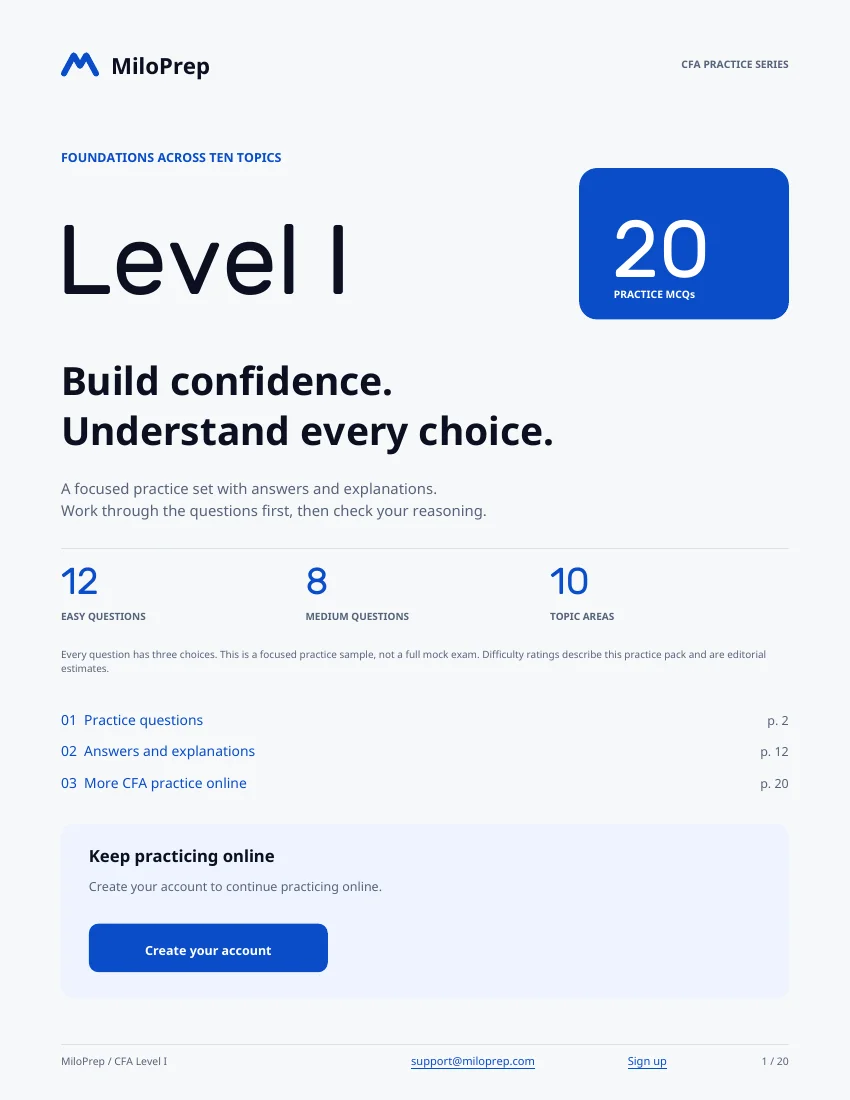
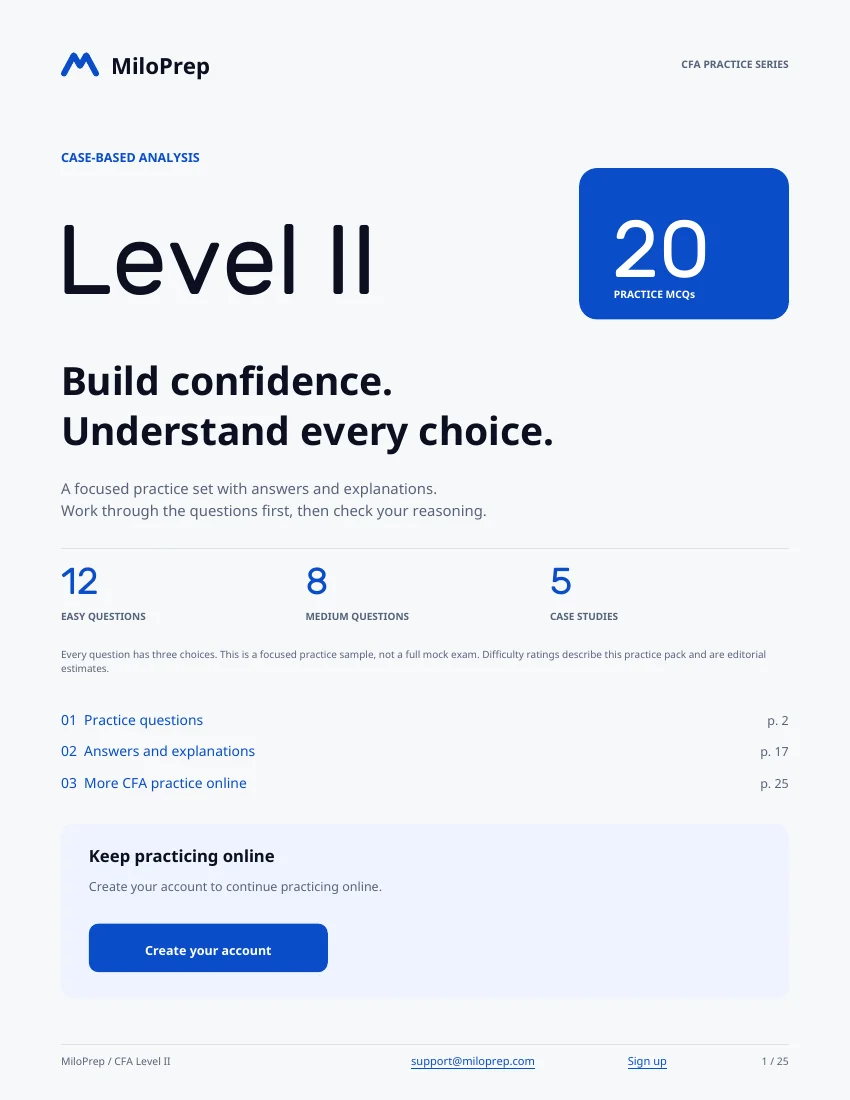
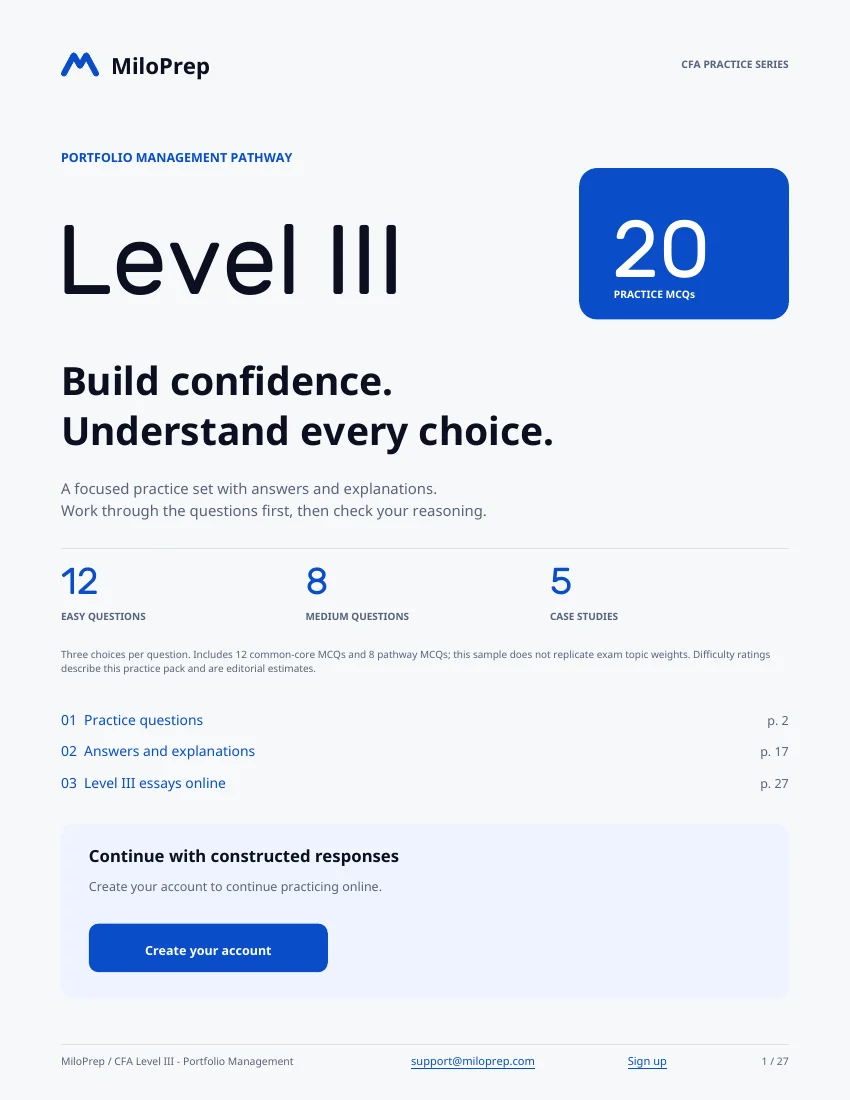
Free PDF by email
All 5 CFA practice PDFs, in one email
Enter your email on the PDF page to receive all 5 printable packs, with answers and explanations. Selected level/pathway questions; see the topic mix before requesting.
No account or payment required for the PDFs. Includes the monthly newsletter; unsubscribe anytime.
PDFs by email, with the monthly newsletter. Account signup opens online practice separately.
Try it here - no account needed
Ten learning exercises
Ten original command-word drills. Models include common errors and teaching checklists, not official marking schemes.
Saved in this tab when storage is available. Responses are not uploaded.
Completed
0 / 10
MCQ correct
0 / 0
Self-reviewed
0
Completion is not an exam score. Written responses are self-reviewed, not automatically graded.
- Question 1 of 10IdentifyWritten response
Case facts
A client must meet a tuition payment in six months. The proposed funding asset is a ten-year lockup fund.
Identify the principal mismatch in one sentence.
Model answer and self-review rubric
The fund's illiquidity conflicts with the client's six-month cash need. Common error: describing expected return without naming the liquidity mismatch.
Teaching checklist only. No official points or automated grade.
- Question 2 of 10CalculateWritten response
Case facts
A portfolio gains 120 on beginning assets of 2,000, with no external flows or income omitted.
Calculate the holding-period return.
Model answer and self-review rubric
120 / 2,000 = 0.06 = 6%. State the answer as a percentage and use the beginning asset value. Common error: dividing by the ending value 2,120.
Teaching checklist only. No official points or automated grade.
- Question 3 of 10JustifyWritten response
Case facts
A liability is due in two years in currency X. Bond A matches its currency and payment date; Bond B matures in ten years in currency Y.
Select the better match and justify your selection with two distinct reasons.
Model answer and self-review rubric
Select Bond A. Its payment timing matches the two-year liability. Its currency matches currency X. Common error: saying A is safer twice without giving two separate case-linked reasons.
Teaching checklist only. No official points or automated grade.
- Question 4 of 10CompareWritten response
Case facts
Manager A has active return 2% and tracking error 4%; Manager B has active return 3% and tracking error 10%, with consistent measurement periods.
Compare their information ratios and state one limitation of that comparison.
Model answer and self-review rubric
A has IR 0.50 and B has IR 0.30, so A has more active return per unit of active risk on these inputs. The comparison still depends on benchmark suitability and estimation quality. Common error: selecting B solely for higher active return.
Teaching checklist only. No official points or automated grade.
- Question 5 of 10ExplainWritten response
Case facts
Asset and liability durations are equal, but their currency exposures differ.
Explain why duration matching does not eliminate all surplus risk.
Model answer and self-review rubric
Duration matching addresses a particular interest-rate sensitivity, not the currency mismatch. Exchange-rate moves can change assets relative to liabilities. Common error: claiming all risk is removed when one statistic matches.
Teaching checklist only. No official points or automated grade.
- Question 6 of 10RecommendWritten response
Case facts
An investor has a long investment horizon but cannot meet unpredictable capital calls without selling emergency reserves.
Recommend one modification before adding a private fund commitment.
Model answer and self-review rubric
Reduce the commitment or establish a funded liquidity plan that protects the emergency reserve and covers plausible calls. A long horizon does not remove interim funding needs. Common error: treating horizon as the only suitability constraint.
Teaching checklist only. No official points or automated grade.
- Question 7 of 10DiscussWritten response
Case facts
A trader splits a large buy order over several days in a liquid but rising market.
Discuss one benefit and one cost of slower execution.
Model answer and self-review rubric
Smaller slices may reduce immediate market impact. Waiting can increase purchase cost as the market rises or leave the order incomplete. Common error: listing only benefits when a trade-off is requested.
Teaching checklist only. No official points or automated grade.
- Question 8 of 10Determine and justifyWritten response
Case facts
A portfolio has beta 1.0 and the investment policy raises its target to 1.2. Suitable index futures have positive beta.
Determine whether to buy or sell futures and justify the direction.
Model answer and self-review rubric
Buy futures to add positive market exposure and move beta upward. Common error: giving a contract count without answering the requested direction.
Teaching checklist only. No official points or automated grade.
- Question 9 of 10Evaluate a claimWritten response
Case facts
An analyst says a private fund with TVPI 1.5 has returned 150% of contributions in cash. Its DPI is 0.4.
Evaluate the claim using the supplied measures.
Model answer and self-review rubric
The claim is false. DPI 0.4 describes distributions relative to paid-in capital; TVPI 1.5 includes remaining NAV, so 1.1 times is residual value on a consistent basis. Common error: confusing a multiple with a percentage gain.
Teaching checklist only. No official points or automated grade.
- Question 10 of 10State a limitationWritten response
Case facts
A ten-question online diagnostic reports six correct MCQs and two self-reviewed written responses.
State why this cannot support a predicted CFA pass probability.
Model answer and self-review rubric
The sample is small, uncalibrated and not representative of the full exam; self-review is not independent grading. It can identify observed review targets, not a pass likelihood. Common error: treating completion as demonstrated mastery.
Teaching checklist only. No official points or automated grade.
Apply the topic to a focused case
CFA Level 3 constructed-response command-word drill
For identify, state the requested item directly. If the prompt asks for one constraint, provide the relevant constraint instead of a list of everything the client might face. Select the case fact that distinguishes your answer. Unrequested additions can introduce contradictions and make it harder to see that you answered the actual prompt.
- Case facts
- The same client needs 100,000 next month from a 500,000 portfolio. The prompt separately asks you to identify the liquidity need, calculate its portfolio share, and justify using a daily-liquid fund.
- Apply the method
- Identify: 100,000 needed next month. Calculate: 100,000 / 500,000 = 20%. Justify: daily liquidity can meet the dated withdrawal.
- Interpretation
- Each command receives the output it asks for: a named need, a labeled percentage, or a supported decision. These are independent teaching responses, not official scoring rubrics.
Independent teaching cases under the stated assumptions, rather than official questions or scoring keys.
Keep this checklist handy
What to do, at a glance
01Before you write
- Identify the command word.
- Count the requested responses.
- Note the units and required case evidence.
02Make every line count
- Give the conclusion first.
- Attach one specific case fact to each justification.
- Follow official response-count and calculation instructions.
03Review, then retry
- Compare your answer with the model.
- Use the checklist to record self-review, not an official mark.
- Rewrite the weakest answer more directly.
Put one idea into practice.
Try it first. Check the reasoning. Pick your next task.
Quick answers
Does this replace the official curriculum?
No. This is selected independent practice, not a complete syllabus or official exam. Check your exam-year outline.
Can I sign up from this preview?
Yes. Sign up to create your account and practice in the app. Public exercises remain available without an account; answers from this preview are not transferred.
Sources
Selected 2026 teaching content. Official sources do not endorse or verify these examples.
MiloPrep is an independent study resource, not affiliated with or endorsed by CFA Institute. CFA® and Chartered Financial Analyst® are trademarks owned by CFA Institute.
Notes
- * What each command word needs: Original teaching patterns, not official answers or grading rubrics. The free PDF packs contain MCQs; written exercises remain on this page. ↩ Return to content