CFA Level 3 Portfolio Construction: notes and free practice
CFA Level 3 Portfolio Construction translates client or institutional objectives into an implementable portfolio. Connect the allocation and strategy to liquidity, liabilities, risk capacity and governance constraints.
The key ideas, at a glance

Fund the cash need
Read the visual, then follow the worked example below. Use the stated case assumptions.
Illustrative worked case
million
- Liquid assets
- 12
- Spending
- -5
- Stressed calls
- -4
- Buffer
- 3
The modeled buffer is 12 - 5 - 4 = 3 million before other obligations. Additional shocks can reduce it further.
| Concept | Rule or decision | Common mistake |
|---|---|---|
| Fund the cash need | Time horizon and liquidity can point in different directions. | A perpetual investor can still face a severe near-term cash shortfall. |
| Assign bonds a job | Income, diversification and liability matching are different mandates. | Duration alone does not capture credit losses or every yield-curve change. |
| Choose the implementation | Judge active choices after fees, capacity limits and tax effects. | A cheaper vehicle is not automatically suitable; exposure and liquidity must also fit. |
| Price the trade-off | Faster execution can reduce delay risk while increasing market impact. | Low commission does not mean low total trading cost. |
01Fund the cash need
Time horizon and liquidity can point in different directions.
Watch for: A perpetual investor can still face a severe near-term cash shortfall.
02Assign bonds a job
Income, diversification and liability matching are different mandates.
Watch for: Duration alone does not capture credit losses or every yield-curve change.
03Choose the implementation
Judge active choices after fees, capacity limits and tax effects.
Watch for: A cheaper vehicle is not automatically suitable; exposure and liquidity must also fit.
04Price the trade-off
Faster execution can reduce delay risk while increasing market impact.
Watch for: Low commission does not mean low total trading cost.
Selected 2026 study concepts. Match your preparation to your registered exam-year curriculum. These notes are not complete curriculum coverage.
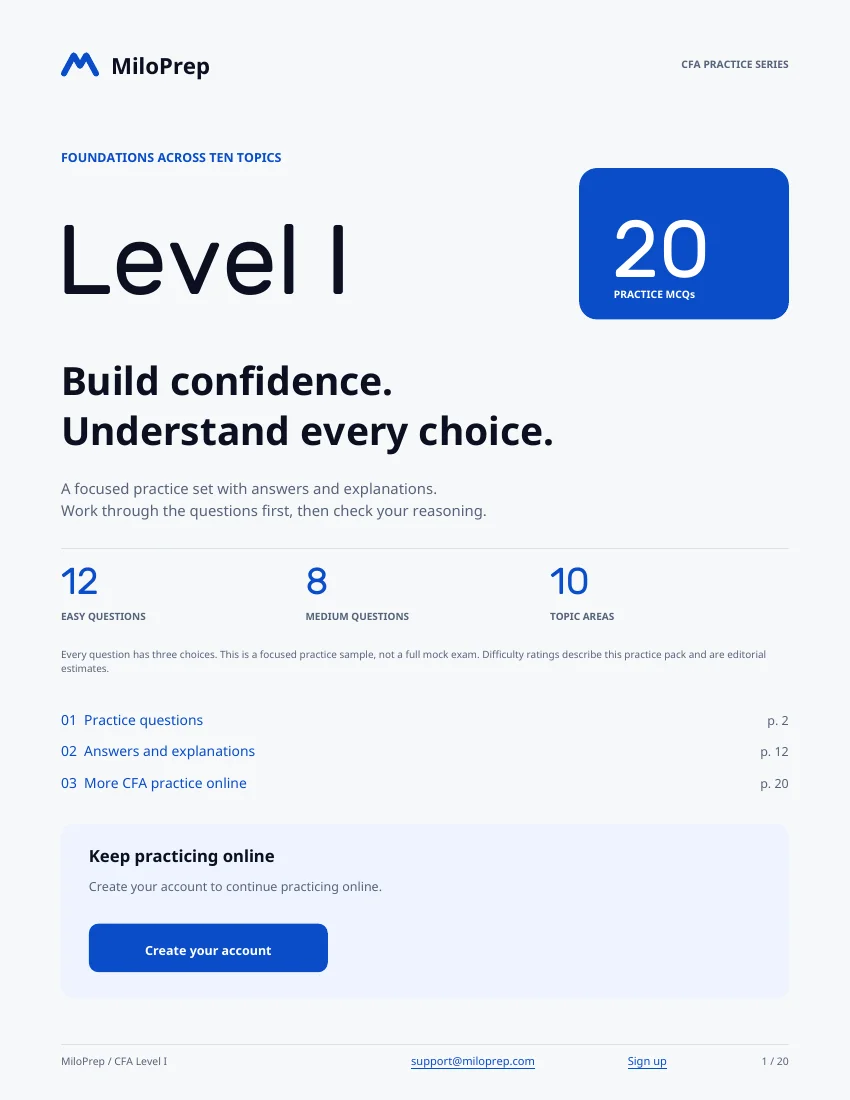

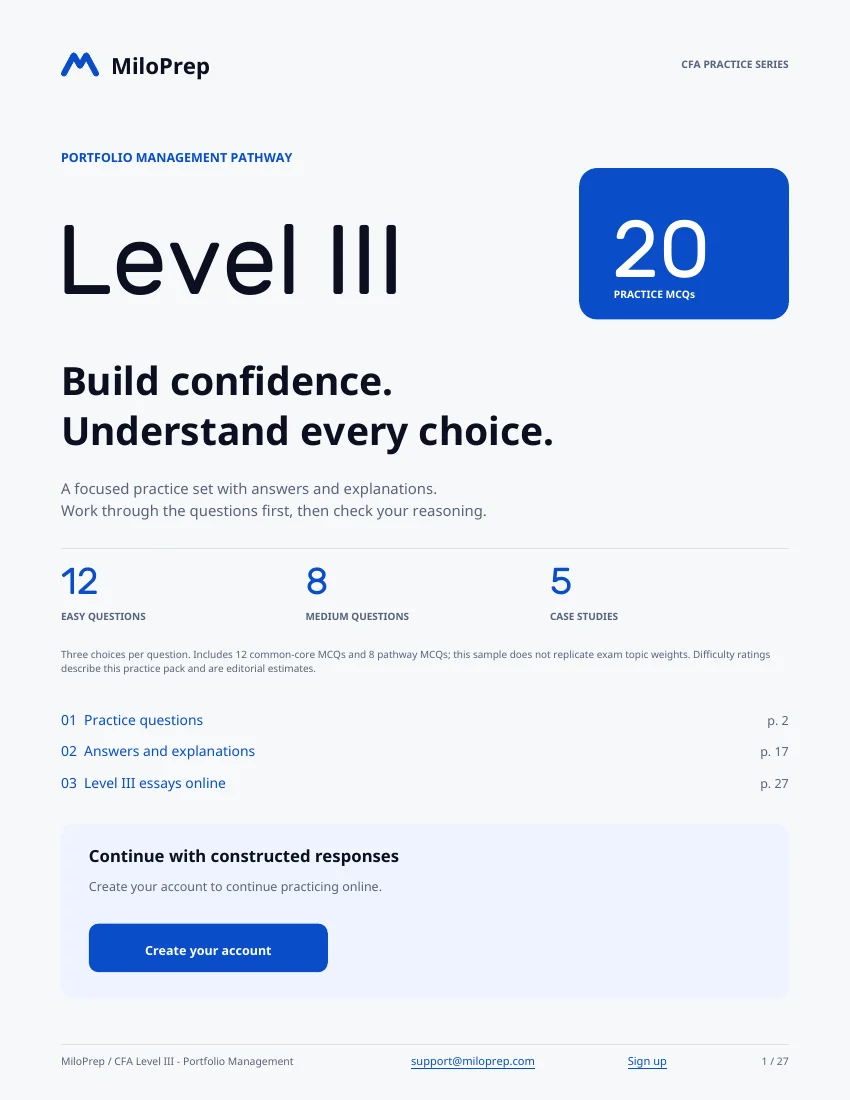
Free PDF by email
All 5 CFA practice PDFs, in one email
Enter your email on the PDF page to receive all 5 printable packs, with answers and explanations. Selected level/pathway questions; see the topic mix before requesting.
No account or payment required for the PDFs. Includes the monthly newsletter; unsubscribe anytime.
Common core, for all three pathways. Selected 2026 concepts, not complete curriculum coverage. Choose pathway-specific practice or check 2027 changes.
Put the method to work
One worked example, from facts to answer
Given
A fund has 12 million liquid assets, 5 million spending and 4 million stressed capital calls.
Method
12 - 5 - 4 = 3 million before other obligations.
Answer and interpretation
Only 3 million remains as the modeled buffer; test additional shocks.
Original independent teaching example. Assumptions are stated above; this is not an official exam question or scoring key.
Try it here - no account needed
10 free Portfolio Construction questions
Five multiple-choice questions and five written prompts. Self-review written answers against teaching rubrics, not official scoring keys. Short independent cases, not a mock or pass prediction.
Saved in this tab when storage is available. Responses are not uploaded.
Completed
0 / 10
MCQ correct
0 / 0
Self-reviewed
0
Completion is not an exam score. Written responses are self-reviewed, not automatically graded.
- Question 1 of 10Level III common-core samplePortfolio ConstructionMultiple choice
Case facts
An endowment has 15 million in liquid assets, expected annual spending of 6 million and stressed private-fund calls of 5 million.
What liquid buffer remains after these modeled cash needs?
Answer and explanations
The remaining buffer is 15 - 6 - 5 = 4 million, before any additional obligations.
Review the method- A - correct: The remaining buffer is 15 - 6 - 5 = 4 million, before any additional obligations.
- B: Nine million subtracts spending but omits the capital calls.
- C: Ten million subtracts calls but omits the annual spending.
- Question 2 of 10Level III common-core samplePortfolio ConstructionMultiple choice
Case facts
A 20 million bond portfolio has modified duration 5. Assume a parallel yield rise of 0.4 percentage points and ignore convexity.
What is the approximate price-value change?
Answer and explanations
The first-order change is -5 × 0.004 × 20 million = -400,000.
Review the method- A: Bond prices fall, not rise, when yields increase under these assumptions.
- B - correct: The first-order change is -5 × 0.004 × 20 million = -400,000.
- C: A 0.4 percentage-point yield change is 0.004, not 0.0004.
- Question 3 of 10Level III common-core samplePortfolio ConstructionMultiple choice
Case facts
An active mandate expects 1.2% gross active return. Its incremental fee is 0.6% and incremental trading cost is 0.3%.
What is its expected net active return before taxes?
Answer and explanations
Expected net active return is 1.2% - 0.6% - 0.3% = 0.3%, not a guaranteed excess return.
Review the method- A: 0.9% subtracts trading cost but ignores the incremental fee.
- B: 0.6% subtracts the fee but ignores incremental trading cost.
- C - correct: Expected net active return is 1.2% - 0.6% - 0.3% = 0.3%, not a guaranteed excess return.
- Question 4 of 10Level III common-core samplePortfolio ConstructionMultiple choice
Case facts
A manager decides to buy 2,000 shares at 30.00, fills all at 30.15 and pays 40 in commission. No shares remain unfilled.
What is the implementation shortfall in currency units?
Answer and explanations
Price slippage is 2,000 × 0.15 = 300; adding 40 commission gives 340.
Review the method- A - correct: Price slippage is 2,000 × 0.15 = 300; adding 40 commission gives 340.
- B: 300 includes price slippage but omits the commission.
- C: 40 captures only explicit commission, not adverse execution-price movement.
- Question 5 of 10Level III common-core samplePortfolio ConstructionMultiple choice
Case facts
An investor pays 25% tax on all investment income. A taxable bond yields 4.8%; a comparable tax-exempt bond yields 3.8%. Ignore other differences.
Which offers the higher after-tax yield?
Answer and explanations
The taxable bond yields 4.8% × 0.75 = 3.6% after tax, below the tax-exempt 3.8%.
Review the method- A: The taxable yield must be reduced for the investor’s stated tax rate.
- B - correct: The taxable bond yields 4.8% × 0.75 = 3.6% after tax, below the tax-exempt 3.8%.
- C: The taxable bond’s after-tax yield is 3.6%, not 3.8%.
- Question 6 of 10Level III common-core samplePortfolio ConstructionWritten response
Case facts
A university endowment is perpetual but relies on investment distributions to cover next year’s operating budget. A proposed private fund has a ten-year lockup.
Explain why the long horizon alone does not justify the investment.
Model answer and self-review rubric
The endowment also has near-term spending needs. Stress liquid assets, capital calls and distributions before accepting the lockup; a long institutional horizon does not make all assets available for illiquid investing.
Review the methodTeaching checklist only. No official points or automated grade.
- Question 7 of 10Level III common-core samplePortfolio ConstructionWritten response
Case facts
A client has a known fixed payment in two years in domestic currency. An adviser proposes a foreign-currency bond maturing in ten years because its yield is higher.
Identify two mismatches that make the proposal a poor cash-flow match.
Model answer and self-review rubric
The currency mismatch exposes the payment to exchange rates, and the maturity mismatch requires a sale before maturity at an uncertain price. A higher yield does not remove either risk.
Review the methodTeaching checklist only. No official points or automated grade.
- Question 8 of 10Level III common-core samplePortfolio ConstructionWritten response
Case facts
A small-cap manager shows strong historical gross returns, but assets have tripled and the same trades now represent a large fraction of daily volume.
Recommend two implementation checks before increasing the allocation.
Model answer and self-review rubric
Estimate capacity and market-impact costs at the larger asset base. Compare realistic net returns and liquidity under normal and stressed markets with the mandate, rather than extrapolating smaller-scale gross performance.
Review the methodTeaching checklist only. No official points or automated grade.
- Question 9 of 10Level III common-core samplePortfolio ConstructionWritten response
Case facts
A manager must urgently reduce exposure after receiving public information. The security is thinly traded; a slow schedule may leave material risk on the book.
Explain the main execution trade-off without assuming one order type is always best.
Model answer and self-review rubric
Faster execution can reduce delay and adverse-price risk but may increase spread and market-impact costs. The manager should weigh urgency against available liquidity and acceptable price risk under the mandate.
Review the methodTeaching checklist only. No official points or automated grade.
- Question 10 of 10Level III common-core samplePortfolio ConstructionWritten response
Case facts
A pension sponsor’s sales and the plan’s equity holdings both depend heavily on the same cyclical industry. The plan is underfunded.
Explain why the sponsor’s condition matters to the plan’s risk capacity.
Model answer and self-review rubric
A downturn can simultaneously reduce plan assets and weaken the sponsor’s ability to contribute. This adverse correlation and underfunding can limit risk capacity even if stakeholders say they are comfortable with volatility.
Review the methodTeaching checklist only. No official points or automated grade.
Four ideas to put to work
Find the method you need
Start with: Investment policy statements, bond duration, liquidity and after-tax returns.
METHOD 01
Fund the cash need
Time horizon and liquidity can point in different directions.
- List committed payments and uncertain calls on capital.
- Stress liquid resources without assuming asset sales always work.
- Reserve enough liquidity before choosing illiquid vehicles.
Worked example
- Given
- A fund has 12 million liquid assets, 5 million spending and 4 million stressed capital calls.
- Calculate / decide
- 12 - 5 - 4 = 3 million before other obligations.
- Result
- Only 3 million remains as the modeled buffer; test additional shocks.
Watch for: A perpetual investor can still face a severe near-term cash shortfall.
Practise this ideaMETHOD 02
Assign bonds a job
Income, diversification and liability matching are different mandates.
- Specify the liability or total-return objective.
- Match currency, timing and risk exposures where needed.
- Check credit, liquidity and reinvestment risks.
Worked example
- Given
- A 10 million bond portfolio has modified duration 4. Yields rise 0.50%.
- Calculate / decide
- First-order price change ≈ -4 × 0.005 × 10 million.
- Result
- Approximately -200,000, before convexity, income and spread changes.
Watch for: Duration alone does not capture credit losses or every yield-curve change.
Practise this ideaMETHOD 03
Choose the implementation
Judge active choices after fees, capacity limits and tax effects.
- Compare the expected benefit with total implementation cost.
- Check mandate fit and investment capacity.
- Test whether returns still meet the investor’s after-tax needs.
Worked example
- Given
- Expected gross active return is 1.0%; incremental fees and trading costs total 0.7%.
- Calculate / decide
- 1.0% - 0.7% = 0.3%.
- Result
- Only 0.3% expected net active return remains, with estimation risk.
Watch for: A cheaper vehicle is not automatically suitable; exposure and liquidity must also fit.
Practise this ideaMETHOD 04
Price the trade-off
Faster execution can reduce delay risk while increasing market impact.
- State the trade’s urgency and information sensitivity.
- Compare spread, impact and opportunity costs.
- Select a method consistent with liquidity and mandate limits.
Worked example
- Given
- Buy 1,000 shares at 50.20 when the decision price was 50.00; commission is 20.
- Calculate / decide
- (50.20 - 50.00) × 1,000 + 20.
- Result
- 220 implementation shortfall for the fully filled order.
Watch for: Low commission does not mean low total trading cost.
Practise this ideaQuestions about this topic
- Why does a long horizon not remove liquidity constraints?
- Payments, capital calls or collateral needs can occur before the long-term objective is reached. A portfolio can have a long horizon and a significant near-term cash requirement at the same time.
- How should a recommendation connect to the IPS?
- Cite the relevant objective and constraint, then explain how the exposure or implementation meets them. An attractive expected return alone does not show suitability.
- Is ability to take risk determined by willingness?
- No. Financial capacity, obligations and consequences of losses constrain ability. Stated enthusiasm for risk is a separate input and may conflict with that capacity.
Apply the topic to a focused case
CFA Level 3 behavioural biases in portfolio decisions
Identify the behavior described before naming a bias. Anchoring can appear when an initial price or forecast continues to dominate despite new information. The relevant issue is the failure to update appropriately, not simply the use of a historical figure. Explain how that behavior can distort a valuation, trading threshold or allocation decision in the specific case.
- Case facts
- A manager reads only favorable reports about a concentrated holding and dismisses a deteriorating cash-flow forecast without examining its assumptions.
- Apply the method
- The selective evidence pattern is consistent with confirmation bias. Require a documented challenge to the thesis using the adverse forecast and alternative explanations.
- Interpretation
- The response targets the decision process. It does not establish that the holding must be sold without evaluating the new evidence and portfolio constraints.
CFA Level 3 institutional portfolio construction cases
Identify the institution and the economic obligation the portfolio serves. A pension may focus on benefit liabilities and funded status; an endowment may support spending while preserving long-term purchasing power. An insurer’s cash flows and regulation create another setting. Do not transfer one institution’s objectives mechanically to another simply because both have a long horizon.
- Case facts
- An endowment expects 4 million of spending, 2 million of capital calls and 1.5 million of reliable inflows during the same next-year period. Ignore other cash flows and an additional reserve buffer.
- Apply the method
- Net modeled liquidity need = 4 + 2 - 1.5 = 4.5 million.
- Interpretation
- Plan for the 4.5 million modeled need, then consider timing uncertainty and reserves. A long investment horizon does not eliminate those cash obligations.
Independent teaching cases under the stated assumptions, rather than official questions or scoring keys.
Sources and curriculum scope
Official outlines establish curriculum scope. The explanations and worked examples are independent teaching material; the sources do not verify or endorse them.
- 2026 Level III common-core outline: Portfolio Construction
- Official Level 3 format and curriculum
- 2026 CFA Level 3 portfolio management outline
- 2027 CFA Level 3 portfolio management outline
MiloPrep is an independent study resource, not affiliated with or endorsed by CFA Institute. CFA® and Chartered Financial Analyst® are trademarks owned by CFA Institute.